



This rating describes our personal assessment of the user-friendliness of the product. How easy is the onboarding process? How modern is the user interface and is it easy to use? Are all the important functions quick and easy to find? We ask ourselves all these questions in order to give a personal rating from 1 to 10 points.
For products or services in the crypto space, trust and security should be the biggest factors in the selection process. Since we could not seriously evaluate the technical security of a platform or product, we analyze publicly available factors such as security features, certifications, audits, team/company, general reputation and, of course, track record.
Crypto doesn't have to be cryptic. Especially for beginners, the first contact with the crypto world can be overwhelming. With this rating, we give our assessment of how easy it is for beginners to find their way around: from the onboarding process to using the most important functions.
Customer support is an important factor for many users. A long wait or no response at all in the event of problems can be frustrating, especially when it comes to sensitive topics such as finances. With this rating, we give our assessment of the quality of customer support. In order to provide as balanced an assessment as possible, we also include user opinions from other platforms in our evaluation.
Some exchanges and brokers are regulated by financial supervisory authorities in certain countries/states. This often entails strict financial regulatory requirements and compliance requirements to which the company must adhere. Regulatory clarity can contribute to greater transparency and thus also greater trustworthiness.
Do you have ideas or suggestions for changes? Then we look forward to your feedback! We make every effort to keep all metrics and information as up-to-date as possible. However, if you discover an error or outdated information, we would be delighted to hear from you.
Feel free to write to us:

A wallet that is “open source” makes its software code public (e.g. on Github). Either the entire program code or at least significant parts of it are publicly accessible. This has the advantage that many parties can review the code and security gaps or other vulnerabilities are discovered and improved more quickly.
The so-called "private key" is a unique sequence of numbers and characters and the private key that gives you direct access to and control over your cryptocurrencies. The private key is used to sign transactions. In simple terms, it can be seen as a digital fingerprint that proves that you are the owner of the cryptocurrencies. If you store your cryptocurrencies on so-called "custodial wallets" (e.g. crypto exchanges), you are not the owner of your private keys.
The anonymity of “non-custodial wallets” is generally relatively high. However, there are differences between providers when it comes to collecting and storing user data. There can also be differences in the ordering process for hardware wallets as to which user data is stored and for what period of time
The so-called “secure element” is a chip (microprocessor) that stores your private key and is separated from the rest of the hardware. This special chip gives the hardware wallet significantly more protection against local, physical attacks. Depending on the chip, a different level of security can be offered. Some chips can be compromised with less effort, while with others this is only possible with special equipment and is extremely complex.
The so-called “secure element” is a chip (microprocessor) that stores your private key and is separated from the rest of the hardware. This special chip gives the hardware wallet significantly more protection against local, physical attacks. Depending on the chip, a different level of security can be offered. Some chips can be compromised with less effort, while with others this is only possible with special equipment and is extremely complex.
The overall rating is the average of our individual ratings. Our ratings do not constitute investment advice, but merely our personal opinion. You are welcome to use them as rough indicators and additional perspective. In the dynamic and fast-growing crypto sector, parameters can often change from one day to the next, so we cannot guarantee that the rating data is up to date. Therefore, please never use our ratings as an isolated basis for decision-making and not as a substitute for your own research.
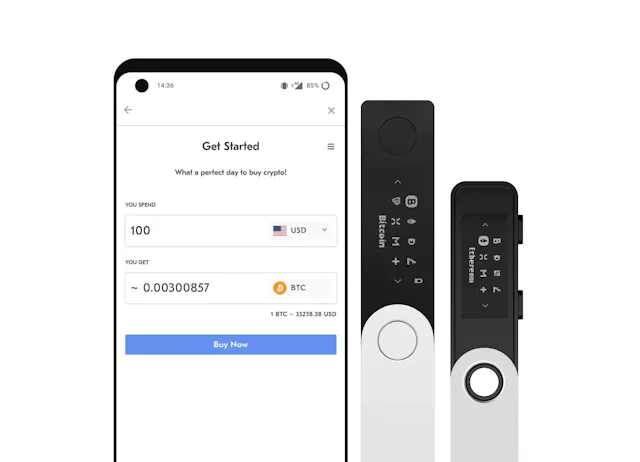
Some wallets offer an integrated trading function within the wallet to buy and sell cryptocurrencies directly. This functionality is usually made possible by a connection to the web interface of an exchange. The integrated trading function in wallets offers enormous advantages: cryptocurrencies can be bought in the same place where they are to be stored. The manual transfer of cryptocurrencies from an exchange to your own wallet is therefore no longer necessary, which can save time and money.
Multisignature wallets or multisig wallets are wallets that require at least two private keys to sign a transaction. This additional process makes it possible to greatly increase security against unwanted access, for example through personal threats. This security mechanism is particularly useful when storing particularly high assets.
If the hardware wallet or the device with the corresponding software wallet is lost or damaged, there is no need to panic. As long as you have your private key or recovery seed (also called “seed phrase”) in your possession, you can restore your wallet at any time. The recovery seed is a combination of 12-24 words and is the most common backup method for wallets. Important: Keep your recovery words and private keys secret and never share them with other people!




Ledger Nano X Review

Exchange Flow is reader-supported. We may earn a commission when you sign up through our links. Commissions do not influence our ratings or rankings. Advertiser Disclosure

In our view, the Ledger Nano X is a good hardware wallet for people who want to approve transactions from an iPhone or an Android phone. It pairs over Bluetooth, keeps your keys on a secure element chip certified to CC EAL5+, holds up to 100 apps and, according to Ledger, can manage more than 15,000 coins and tokens. It costs $99 in Ledger's online shop. The main trade-off is its small screen, on which checking a transaction takes several steps, and it lacks the Transaction Check scam warning of Ledger's touchscreen models.


Ledger Nano X
Overview
Quick Facts
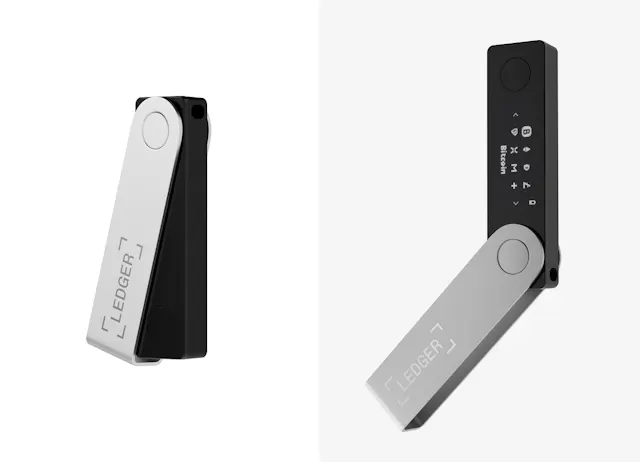
The Ledger Nano X is a hardware wallet that keeps your private keys on a secure element chip and connects to phones over Bluetooth and to computers over USB-C. Ledger lists it among its classic signers for backup use, next to its touchscreen models.
Informations




Pro's & Con's
- Bluetooth pairing with iPhones and Android phones, plus USB-C for computers.
- Secure element chip certified to CC EAL5+ for your private keys.
- Room for up to 100 apps and, according to Ledger, more than 15,000 supported coins and tokens.
- Bitcoin multisig, PSBT and miniscript through the Ledger Bitcoin app.
- Small screen with Clear Signing as a multi-step process, and no Transaction Check scam warning, which Ledger offers only on its touchscreen models.
- Chip certified to CC EAL5+, while the Nano S Plus and Ledger's touchscreen models use EAL6+ chips.
- The battery lasts up to 5 hours of use, according to Ledger.
- Swap quotes in Ledger Wallet include a Ledger fee, and Ledger publishes no percentage.
Ledger Nano X
Hardware
Offer and features of
Ledger Nano X
Functionality
Unique Features
- Bluetooth connection
- Ledger Wallet app (formerly Ledger Live)
- Up to 100 apps
Platforms
Our
Ledger Nano X
Review
Our Rating

Conclusion
In our view, the Ledger Nano X is a good hardware wallet for people who want to approve transactions from an iPhone or an Android phone. It pairs over Bluetooth, keeps your keys on a secure element chip certified to CC EAL5+, holds up to 100 apps and, according to Ledger, can manage more than 15,000 coins and tokens. It costs $99 in Ledger's online shop. The main trade-off is its small screen, on which checking a transaction takes several steps, and it lacks the Transaction Check scam warning of Ledger's touchscreen models.
Customer Reviews
/ 5 average rating from 1 reviews

...
Write a Review
Share your experience! Your review can help others make informed decisions. Let us know what worked well and what could be improved. Your feedback is valuable and will contribute to our community’s knowledge.




In our view, the Nano X is easy to live with once it is set up. You manage it from one app, Ledger Wallet, and the Bluetooth connection lets you approve a transfer from an iPhone or Android phone without a cable. You confirm every action with the two buttons. The 1.1-inch screen shows 128 x 64 pixels.
The Nano X holds up to 100 apps at once. In Ledger Wallet you can send and receive crypto, buy, sell and swap it through Ledger's partners, and stake it.
Ledger says the Nano X can manage more than 15,000 coins and tokens. The Ledger Wallet app supports more than 500 of them directly, Bitcoin, Ethereum, Solana and XRP among them; any other coin or token needs a compatible third-party wallet. For a small token, check Ledger's list before you buy.
Your private keys stay on a secure element chip certified to CC EAL5+. Only if you subscribe to the optional Ledger Recover service does an encrypted copy, split into three fragments, leave the device, and Recover requires an identity check. The French CSPN certificate for the Nano X expired in July 2026. Ledger has had customer data leaks in 2020 and a malicious Connect Kit release in 2023 that drained users of third-party apps; Ledger says its hardware was not affected. In January 2026, Ledger reported an incident at its e-commerce partner Global-e and said it was separate from its devices and software. In our view, the main risk to plan for is phishing aimed at your 24-word recovery phrase.
In our view, the Nano X is a good first hardware wallet if you mostly use a phone. Setup runs through the Ledger Wallet app, and the step that matters most is writing down the 24-word recovery phrase. Anyone with those words can rebuild your wallet without the device. If price matters more to you than Bluetooth, the Nano S Plus is the cheaper Ledger.
Ledger handles support through a chat on its support site. An AI chatbot called LedgerBot answers first, and you can ask for a human agent at any time by typing "Agent"; Ledger says it offers email and, when available, live chat. Ledger does not offer phone support and warns that callers who claim to be Ledger Support are scammers.
In our view, the Ledger Nano X does the core job of a hardware wallet well, and it is the least expensive Ledger that works with an iPhone. If you only use a computer or an Android phone, read our Ledger Nano S Plus review; if you prefer open-source firmware, see our Ledger vs Trezor comparison. Our rating method explains how we score wallets.
About
Ledger Nano X
Ledger Nano X
Ledger Nano X Review: Bluetooth, Security, Fees and Who It Suits
Our verdict: in our view, the Ledger Nano X is a good hardware wallet for those who want to approve transactions from their phone, including an iPhone, without the need for a cable. It connects via Bluetooth and protects private keys with a secure element chip certified to CC EAL5+. The device is priced at $99 in Ledger's online shop. According to Ledger, it can manage over 15,000 coins and tokens.
The Nano X suits you if:
- you require a hardware wallet compatible with the Ledger Wallet app on an iPhone, which the less expensive Ledger Nano S Plus does not support.
- you hold coins across multiple blockchains and wish to manage them in a single app.
- you use Bitcoin multisig, with support from the Ledger Bitcoin app.
The Nano X may not be the right fit if:
- you solely use a computer or an Android phone and prefer to spend less: our Ledger Nano S Plus review covers the $69 model.
- you desire device firmware released under an open-source license, which is the approach taken by Trezor, as explained in our Ledger vs Trezor comparison.
Ledger Nano X at a glance
- Maker: Ledger SAS, registered in Paris, France
- Custody: You hold the keys. The device doesn't store your coins. It signs transactions.
- Chip: ST33J2M0 secure element, certified to CC EAL5+.
- Connections: Bluetooth for iOS and Android phones, USB-C for computers.
- Screen: 1.1 inches, 128 x 64 pixels, with two buttons.
- App: Ledger Wallet (formerly Ledger Live) for Windows, macOS, Linux, iOS, and Android.
- Backup: A 24-word recovery phrase, with the paid Ledger Recover service as an option.
Setup and everyday use
Setting up the Nano X and managing your accounts is done through Ledger Wallet, the app formerly known as Ledger Live. Ledger states the Nano X isn't compatible with Chromebooks. For computer use, the USB-C cable in the box connects the device. On a phone, pairing over Bluetooth is possible, which we believe is the main advantage over the Nano S Plus, which Ledger says doesn't support iOS devices. According to Ledger, the battery lasts up to 5 hours.
Every action requires confirmation with the two buttons. Ledger describes Clear Signing on the Nano X as a multi-step process on a small screen. Updates continue for the device. The latest Ledger OS release for the Nano X added Clear Signing features, like displaying the names saved for addresses. Transaction Check, Ledger's warning about common scams before signing, is listed only for its touchscreen models, Stax, Flex, and Nano Gen5.
Security and backup
The ST33J2M0 chip holds your keys and is certified to CC EAL5+. In contrast, the Nano S Plus and Ledger's touchscreen models use the ST33K1M5, certified to CC EAL6+. The Nano X operates with BOLOS, which Ledger refers to as a proprietary operating system, while the Ledger Wallet app's code is open on GitHub. The French cybersecurity agency ANSSI had certified the Nano X under its CSPN scheme, though this certificate expired in July 2026.
The backup involves a 24-word recovery phrase, written on sheets provided in the box. Having these words allows anyone to rebuild your wallet without the device. Ledger Support says it will never ask for them. Ledger Recover is an optional subscription costing $9.99 monthly, where a version of your private key is encrypted and split into three fragments held by Coincover, Ledger, and EscrowTech, with two needed to restore access after identity verification with a passport or national ID card. Ledger emphasizes that Recover is opt-in. Ledger's Recovery Key backup card is sold separately for $39 and works with Ledger's NFC models, the Stax, Flex and Nano Gen5, which include one in the box, so it does not work with the Nano X.
Ledger has also had security incidents. In 2020, a breach of its e-commerce and marketing database exposed about 1 million customer email addresses, and in December 2020 the names, postal addresses and phone numbers of about 272,000 customers were published online; Ledger said many customers were then targeted by phishing. In December 2023, an attacker phished a former Ledger employee and published malicious versions of the Ledger Connect Kit, a code library that apps use to connect to Ledger devices, and users who signed in affected third-party apps had their wallets drained. Ledger deployed a fix within 40 minutes of becoming aware and says its hardware and Ledger Live were not affected. In January 2026, Ledger said an incident at Global-e, its e-commerce partner, was separate from its hardware, software and platforms, and that Global-e has no access to your 24 words or blockchain balance.
Coins and features
The device can hold up to 100 apps simultaneously. For Bitcoin, the Ledger Bitcoin app supports multisig, PSBT, and miniscript, and since version 2.4.0, it also includes MuSig2. In Ledger Wallet, users can stake crypto and follow rewards in the Earn section. The Nano X can also function as a passkey for two-factor logins, over USB only.
What the Nano X costs
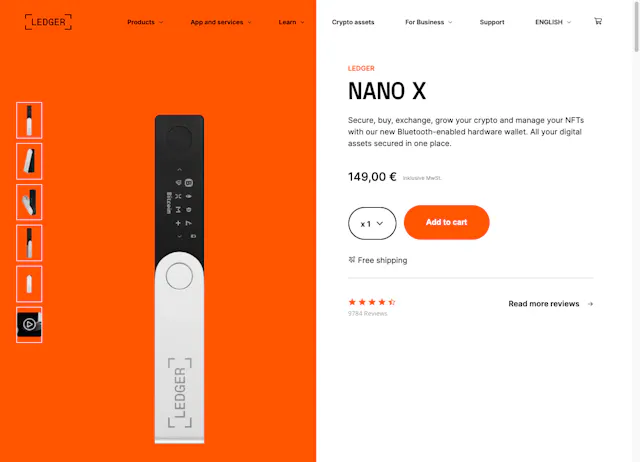
The device costs $99 in Ledger's online shop. Ledger charges no fee for sending crypto: you pay the network fee, which varies, at one of three estimated levels or a custom fee. Buying, selling and swapping run through partner companies, depending on your country. A swap quote has a Ledger fee and a partner fee built in, but Ledger publishes no percentage, so compare the amount you will receive before you confirm.
Buying a Nano X in the US
Ledger ships the Nano X to the US. Its shipping FAQ lists countries like Belarus, Cuba, and Iran, which it cannot ship to, but the US isn't among them. Orders from the US are sold by Global-e US Inc. In Ledger Wallet, PayPal is available to buy crypto only for users in the United States, with other partners varying by location.
Who should buy it, and the alternatives
In our view, the Nano X fits beginners and long-term holders who manage their coins from a phone, iPhone users in particular. If you only use a computer or an Android phone, the Ledger Nano S Plus costs $69 and has the newer EAL6+ chip and the same room for 100 apps, but no Bluetooth. If you want to check transactions on a larger screen with Transaction Check, Ledger's touchscreen models cost more: the Nano Gen5 is $179, the Flex $249 and the Stax $399. If open-source firmware matters most to you, our Ledger vs Trezor comparison covers Trezor's current models, starting with the Safe 3 at $59. We also compare the Nano X with BitBox and SafePal, and our wallet overview lists every wallet we review.
About the author
Ethan Parker is Senior Content Editor at Exchange Flow. He has followed crypto since 2015, from Bitcoin and Ethereum to the exchanges people use to buy and trade them.
Probable one of the best wallets out there. I personally own tow Ledger Nano X and love the initiative design, as well as the simplicity when making transactions with the hardware wallet.