



This rating describes our personal assessment of the user-friendliness of the product. How easy is the onboarding process? How modern is the user interface and is it easy to use? Are all the important functions quick and easy to find? We ask ourselves all these questions in order to give a personal rating from 1 to 10 points.
For products or services in the crypto space, trust and security should be the biggest factors in the selection process. Since we could not seriously evaluate the technical security of a platform or product, we analyze publicly available factors such as security features, location, regulation, certifications, audits, team/company, general reputation and, of course, track record.
Crypto doesn't have to be cryptic. Especially for beginners, the first contact with the crypto world can be overwhelming. With this rating, we give our assessment of how easy it is for beginners to find their way around: from the onboarding process to using the most important functions.
Customer support is an important factor for many users. A long wait or no response at all in the event of problems can be frustrating, especially when it comes to sensitive topics such as finances. With this rating, we give our assessment of the quality of customer support. In order to provide as balanced an assessment as possible, we also include user opinions from other platforms in our evaluation.
Some exchanges and brokers are regulated by financial supervisory authorities in certain countries/states. This often entails strict financial regulatory requirements and compliance requirements to which the company must adhere. Regulatory clarity can contribute to greater transparency and thus also greater trustworthiness.
Do you have ideas or suggestions for changes? Then we look forward to your feedback! We make every effort to keep all metrics and information as up-to-date as possible. However, if you discover an error or outdated information, we would be delighted to hear from you.
Feel free to write to us:

A wallet that is “open source” makes its software code public (e.g. on Github). Either the entire program code or at least significant parts of it are publicly accessible. This has the advantage that many parties can review the code and security gaps or other vulnerabilities are discovered and improved more quickly.
The so-called "private key" is a unique sequence of numbers and characters and the private key that gives you direct access to and control over your cryptocurrencies. The private key is used to sign transactions. In simple terms, it can be seen as a digital fingerprint that proves that you are the owner of the cryptocurrencies. If you store your cryptocurrencies on so-called "custodial wallets" (e.g. crypto exchanges), you are not the owner of your private keys.
The anonymity of “non-custodial wallets” is generally relatively high. However, there are differences between providers when it comes to collecting and storing user data. There can also be differences in the ordering process for hardware wallets as to which user data is stored and for what period of time
The so-called “secure element” is a chip (microprocessor) that stores your private key and is separated from the rest of the hardware. This special chip gives the hardware wallet significantly more protection against local, physical attacks. Depending on the chip, a different level of security can be offered. Some chips can be compromised with less effort, while with others this is only possible with special equipment and is extremely complex.
The so-called “secure element” is a chip (microprocessor) that stores your private key and is separated from the rest of the hardware. This special chip gives the hardware wallet significantly more protection against local, physical attacks. Depending on the chip, a different level of security can be offered. Some chips can be compromised with less effort, while with others this is only possible with special equipment and is extremely complex.
The overall rating is the average of our individual ratings. Our ratings do not constitute investment advice, but merely our personal opinion. You are welcome to use them as rough indicators and additional perspective. In the dynamic and fast-growing crypto sector, parameters can often change from one day to the next, so we cannot guarantee that the rating data is up to date. Therefore, please never use our ratings as an isolated basis for decision-making and not as a substitute for your own research.
Some wallets offer an integrated trading function within the wallet to buy and sell cryptocurrencies directly. This functionality is usually made possible by a connection to the web interface of an exchange. The integrated trading function in wallets offers enormous advantages: cryptocurrencies can be bought in the same place where they are to be stored. The manual transfer of cryptocurrencies from an exchange to your own wallet is therefore no longer necessary, which can save time and money.
Multisignature wallets or multisig wallets are wallets that require at least two private keys to sign a transaction. This additional process makes it possible to greatly increase security against unwanted access, for example through personal threats. This security mechanism is particularly useful when storing particularly high assets.
If the hardware wallet or the device with the corresponding software wallet is lost or damaged, there is no need to panic. As long as you have your private key or recovery seed (also called “seed phrase”) in your possession, you can restore your wallet at any time. The recovery seed is a combination of 12-24 words and is the most common backup method for wallets. Important: Keep your recovery words and private keys secret and never share them with other people!







Trezor Model T vs Ledger Nano X in comparison
Overview

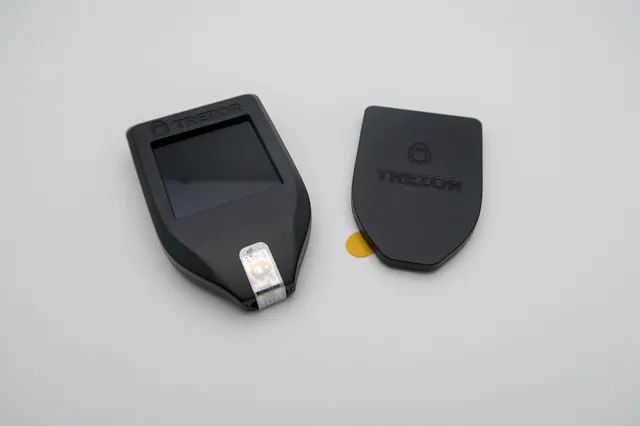
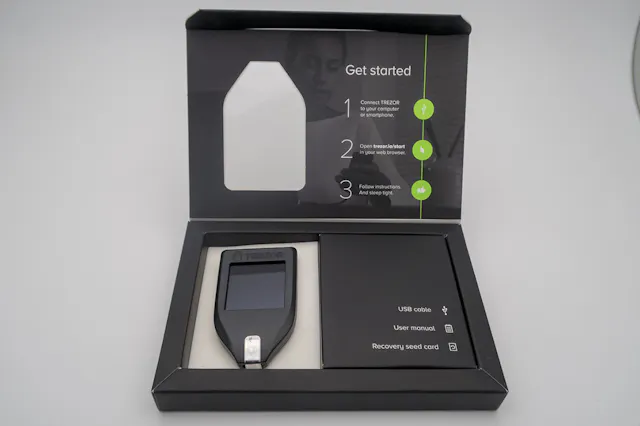
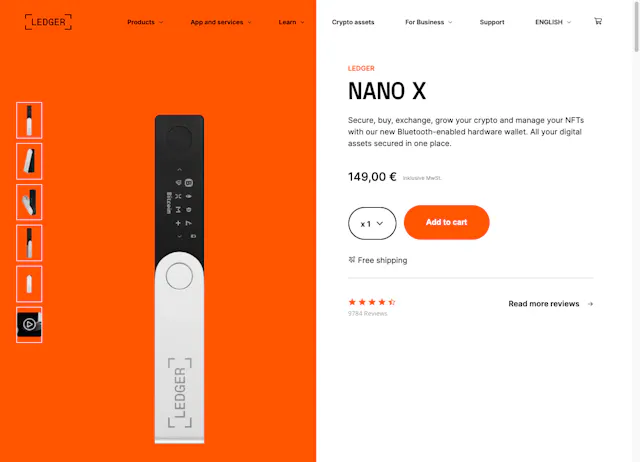
Trezor no longer sells the Model T and offers the Trezor Safe 5 in its place. The Model T has a 1.54-inch color touchscreen, a USB-C port and a microSD card slot, and its firmware is open source. Trezor plans new coin support and basic maintenance until at least 2031 and critical security updates until at least 2036.
- 1.54-inch color touchscreen with 240 x 240 pixels.
- 12-, 20- and 24-word backups plus Advanced Multi-share Backup.
- Firmware published under the GPLv3 open-source license.
- Supports Clear Signing and coins such as XRP, Solana and Cardano, which the Model One lacks.
- Discontinued: Trezor no longer sells it in its online shop.
- No secure element chip; Trezor says a strong passphrase fully mitigates a known physical attack on its chip.
- On iOS, Trezor Suite supports only portfolio tracking, buying and receiving.

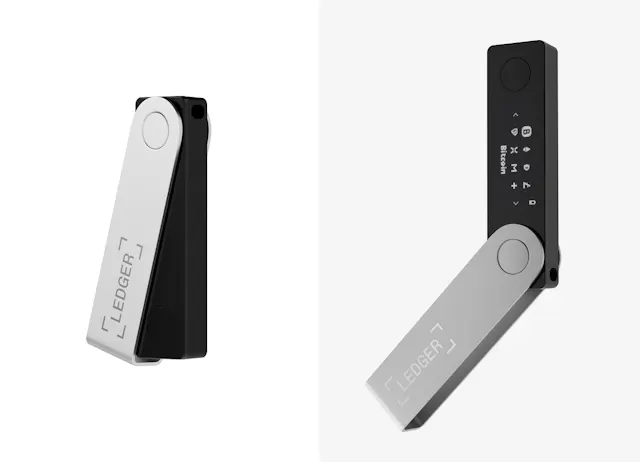
- Bluetooth pairing with iPhones and Android phones, plus USB-C for computers.
- Secure element chip certified to CC EAL5+ for your private keys.
- Room for up to 100 apps and, according to Ledger, more than 15,000 supported coins and tokens.
- Bitcoin multisig, PSBT and miniscript through the Ledger Bitcoin app.
- Small screen with Clear Signing as a multi-step process, and no Transaction Check scam warning, which Ledger offers only on its touchscreen models.
- Chip certified to CC EAL5+, while the Nano S Plus and Ledger's touchscreen models use EAL6+ chips.
- The battery lasts up to 5 hours of use, according to Ledger.
- Swap quotes in Ledger Wallet include a Ledger fee, and Ledger publishes no percentage.
Information

Hardware




Features
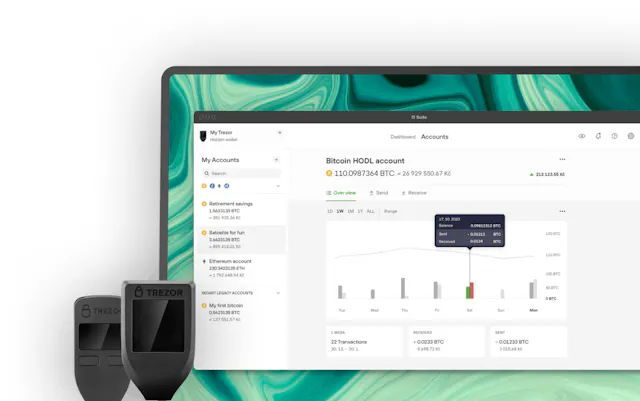
- Trezor Suite App
- Password Manager
- Bluetooth connection
- Ledger Wallet app (formerly Ledger Live)
- Up to 100 apps


Wallet Rating

About
Our Review
The Trezor Model T is discontinued: Trezor stopped selling it in its online shop in January 2026 and offers the Trezor Safe 5 instead. If you own one, it keeps working with Trezor Suite, and Trezor plans new coin support until at least 2031 and critical security updates until at least 2036. In our view, it is still a capable wallet for its owners: the color touchscreen makes confirming transactions easier, it offers 12-, 20- and 24-word backups and Advanced Multi-share Backup, and it supports Clear Signing. For a new purchase, Trezor's replacement is the Safe 5, and our Ledger vs Trezor comparison covers the current models.
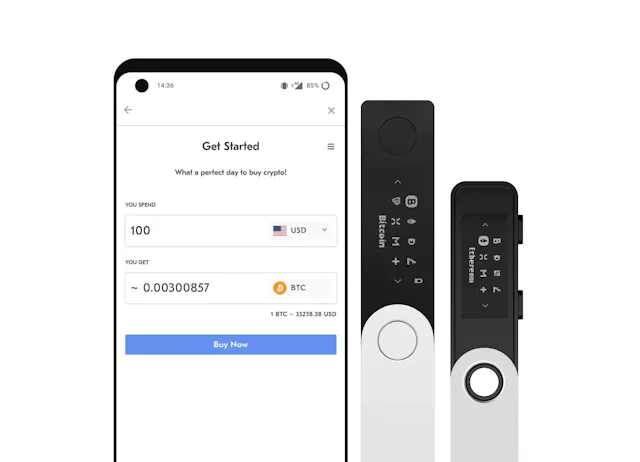
In our view, the Ledger Nano X is a good hardware wallet for people who want to approve transactions from an iPhone or an Android phone. It pairs over Bluetooth, keeps your keys on a secure element chip certified to CC EAL5+, holds up to 100 apps and, according to Ledger, can manage more than 15,000 coins and tokens. It costs $99 in Ledger's online shop. The main trade-off is its small screen, on which checking a transaction takes several steps, and it lacks the Transaction Check scam warning of Ledger's touchscreen models.

Ledger vs Trezor: Prices, Open Code, iPhone Use and Backup
Trezor no longer sells the Model T compared above; the Safe 5 took its place. Below, we compare the current models of both brands. In our view, Trezor is the better pick if you want open-source firmware, the lower entry price with the Safe 3 at $59 and no fee of the wallet maker's own for trades inside its app. Ledger is the better pick if you use an iPhone or want your backup on a PIN-protected card, the Recovery Key included with three models.
Current models and prices
Ledger offers five current models: the Nano S Plus at $69, the Nano X at $99, the Nano Gen5 at $179, the Flex at $249, and the Stax at $399. Trezor provides three models: the Safe 3 at $59, the Safe 5 at $129, and the Safe 7 at $249, with each also available as a Bitcoin-only edition at the same price.
The Safe 3 and Safe 5 have replaced the Trezor Model One and Model T. The pairs to compare, in our opinion, are the Safe 3 with Nano S Plus, the Safe 5 with Nano X or Nano Gen5, and the Safe 7 with Flex or Stax.
Security: chips, open code and track record
All current models use a secure element chip certified to Common Criteria EAL6+, except the Nano X, whose chip is certified to EAL5+. The Safe 7 adds a second one, TROPIC01, which Tropic Square, part of the same SatoshiLabs group as Trezor, built to be independently auditable.
The bigger difference is the code. Trezor releases its device firmware under the GPLv3 open-source license, allowing public review and auditing; its Trezor Suite app is source-available under Trezor's own reference license (T-RSL). Ledger publishes its Ledger Wallet app under the MIT license and device apps like the Bitcoin app under the Apache 2.0 license. However, Ledger OS on the device remains closed. In our view, that makes Trezor the choice for buyers who want to check the code rather than trust the maker.
Both makers have had customer data exposed. A 2020 breach of Ledger's e-commerce and marketing database revealed around 1 million email addresses. In December 2020, records of approximately 272,000 customers, including postal addresses and phone numbers, were released. Ledger states that payment data and funds were unaffected. In December 2023, malicious versions of Ledger's Connect Kit code drained users who signed transactions in third-party apps; Ledger says its devices and Ledger Live (now Ledger Wallet) were not affected. In January 2026, a breach at Global-e, the partner handling Ledger's US orders, led to the exposure of some customers' order data.
In August 2026, Trezor's shipping provider ShipMonk reported a breach; after an update in September, Trezor put the exposed order data at 80,689 customers in total, about 67,000 of them US customers who ordered between November 2019 and August 2021. In September 2026, a breach at newsletter provider Brevo was used to send a phishing email from Trezor's account. Trezor says its devices and systems were not affected in either case. Ledger's security lab, Donjon, also showed that some supply-chain protections of the Safe 3 could be bypassed, which Trezor lists as resolved, and extracted some secrets from the TROPIC01 chip in the Safe 7 with physical access and lab equipment; Trezor says that gives no access to the PIN, funds or wallet backup and cannot be fixed by a firmware update.
Backup and recovery
Trezor's Safe models support 12-, 20-, and 24-word backups and Advanced Multi-share Backup. Each package includes two 20-word backup cards. The Stax, Flex, and Nano Gen5 are supplied with a Ledger Recovery Key: a PIN-protected NFC card with an integrated secure element storing a backup of your 24-word phrase, requiring no identity verification or fee.
Ledger offers Ledger Recover, an opt-in subscription at $9.99 a month, which splits an encrypted version of your wallet secret across Coincover, Ledger, and EscrowTech, restoring access after identity verification with a passport or national ID. In our view, the Recovery Key card addresses the same concern without the need for identity verification.
Everyday use: iPhone, screens and fees
The Nano X, Nano Gen5, Flex and Stax connect over Bluetooth and work with the Ledger Wallet app on iOS; only the Nano S Plus does not work with iOS. At Trezor, only the Safe 7 has Bluetooth and full iOS support. With a Safe 3 or Safe 5, Trezor Suite on iOS is limited to portfolio tracking, buying and receiving, so sending, swapping and setup need Android or a computer.
Trezor's touchscreens are color displays, 1.54 inches on the Safe 5 and 2.5 inches on the Safe 7. Ledger opts for E Ink screens, 2.8 inches on the Nano Gen5 and Flex, and 3.7 inches on the Stax.
Neither maker charges a fee for sending coins: you pay only the network fee, at a level you pick in the app. Buying, selling and swapping run through partner companies in both apps, and the partner decides whether you must verify your identity. Trezor's terms say it charges no fee for these partner services, while Ledger's swap quotes incorporate a Ledger fee and partner fee, without a disclosed percentage. Ledger says its devices can manage 15,000+ coins and tokens, 500+ of them directly in Ledger Wallet, and Trezor says thousands; the makers count differently. For smaller tokens, check each company's list before purchasing.
Buying in the US
Both brands ship to the US and name no state they exclude. Ledger's support page still lists US sales of the Nano Gen5 as pre-orders awaiting FCC approval, while its shop shows the device in stock. One state rule matters: Trezor lists Hawaii, New York and South Dakota as restricted for buying, selling and swapping through partners in Trezor Suite, and users in New York may face drastic limits on purchases. The device itself can still be bought and used there.
Our verdict by criterion
- Entry price: the Safe 3 costs $59 and the Nano S Plus $69
- iPhone use: Ledger, starting with the Nano X at $99 in contrast to the Safe 7 at $249
- Open code: Trezor, with open-source device firmware
- Backup options: Trezor offers Advanced Multi-share Backup, Ledger the Recovery Key card with three models and the paid Recover service
- Fees inside the app: Trezor's terms rule out a Trezor fee on partner trades, while Ledger's swap quotes include a Ledger fee
- Track record: a tie in our view; both makers have had customer data exposed and security findings against their products
Pick neither if you keep only a small amount on an exchange to trade: every move to a hardware wallet and back costs a network fee, and in our view a device pays off once you hold coins for the long term. Our wallet overview lists other wallets, we compare the Nano X with wallets from BitBox and SafePal, and our exchange list for American buyers helps if you still need a place to buy. Single devices are covered in our Ledger Nano X review and, for the predecessor of the Safe 5, our Trezor Model T review.
About the author
At Exchange Flow, Ethan is recognized as the resident crypto expert. With 10+years of experience navigating the waters of global crypto exchanges, Ethan is a trusted voice in the ever-evolving world of digital currencies. He tests and scrutinizes exchanges so you don’t have to, offering reviews and articles that newbies and seasoned traders alike find invaluable. When he’s not coding, Ethan likes to travel and play retro games. He uses his crypto earnings to fund his trip around the globe.