



Do you have ideas or suggestions for changes? Then we look forward to your feedback! We make every effort to keep all metrics and information as up-to-date as possible. However, if you discover an error or outdated information, we would be delighted to hear from you.
Feel free to write to us:

Transferable to your own wallet
Self-custody of cryptocurrencies plays an important role for many users who want to manage their cryptocurrencies and thus their "private keys" themselves and not leave them in the hands of the exchange. Most exchanges offer the option of sending the purchased cryptocurrencies to their own wallet.
Deposit protection describes how a provider safeguards customer assets if it becomes insolvent or loses funds in a hack. Government deposit insurance does not cover crypto held on an exchange: FDIC insurance in the US and the EU deposit guarantee of up to €100,000 per depositor and bank cover money held at banks only. Some exchanges run their own insurance policy or protection fund instead, which covers part of customer assets on terms the exchange sets.
The overall rating is our editorial judgment of the platform as a whole. It draws on the six individual ratings, but it is not their average and has no fixed weights. Our ratings do not constitute investment advice, but merely our personal opinion. You are welcome to use them as rough indicators and additional perspective. In the dynamic and fast-growing crypto sector, parameters can often change from one day to the next, so we cannot guarantee that the rating data is up to date. Therefore, please never use our ratings as an isolated basis for decision-making and not as a substitute for your own research.
This rating describes our personal assessment of the user-friendliness of the product. How easy is the onboarding process? How modern is the user interface and is it easy to use? Are all the important functions quick and easy to find? We ask ourselves all these questions in order to give a personal rating from 1 to 10 points.
This rating describes our assessment of the fee structure of a stock exchange or broker. It is not only the amount of fees that can differ, but also the type of fees. The most common type of fees for crypto exchanges are the "maker/taker" fees or spreads. In some cases, there are also hidden fees that are not recognizable to users at first glance.
For products or services in the crypto space, trust and security should be the biggest factors in the selection process. Since we could not seriously evaluate the technical security of a platform or product, we analyze publicly available factors such as security features, certifications, audits, team/company, general reputation and, of course, track record.
Crypto doesn't have to be cryptic. Especially for beginners, the first contact with the crypto world can be overwhelming. With this rating, we give our assessment of how easy it is for beginners to find their way around: from the onboarding process to using the most important functions.
Customer support is an important factor for many users. A long wait or no response at all in the event of problems can be frustrating, especially when it comes to sensitive topics such as finances. With this rating, we give our assessment of the quality of customer support. In order to provide as balanced an assessment as possible, we also include user opinions from other platforms in our evaluation.
Some exchanges and brokers are regulated by financial supervisory authorities in certain countries/states. This often entails strict financial regulatory requirements and compliance requirements to which the company must adhere. Regulatory clarity can contribute to greater transparency and thus also greater trustworthiness.





Plus500 Review

Exchange Flow is reader-supported. We may earn a commission when you sign up through our links. Commissions do not influence our ratings or rankings. Advertiser Disclosure


Overview
Quick Facts
Plus500 is a multi-asset broker founded in 2008 and listed on the London Stock Exchange, with more than 33 million registered customers since its launch. In the EEA, Plus500CY Ltd offers crypto as CFDs; in the US, Plus500 offers crypto futures instead.
Informations



Pro's & Con's
- Regulated by CySEC in the EEA, with 17 licenses across the group
- No commission to open or close a crypto CFD
- Negative balance protection and segregated client money
- Long or short on 24 cryptocurrencies, next to shares and forex
- Crypto futures for approved US customers through a separate US company
- No real coins: no crypto withdrawals, no wallet, no staking
- 80% of retail CFD accounts lose money with this provider
- Spreads vary by coin, for example 0.15% on Bitcoin and 4.46% on Polkadot at our latest check
- Inactivity fee of up to USD 10 a month after three months without a login
- Crypto leverage for retail clients capped at 1:2
Plus500
Features
Feature Overview


Unique Features
- Fast and reliable order execution
Tradable Assets
- Crypto CFDs
- Stocks
- ETFs
- Currency
- Options
- Indices
- Raw materials
Trading Options
- Derivatives
- Margin trading (leverage)
- Short/Long
Our
Plus500
Review
Our Rating

Customer Reviews
/ 5 average rating from 0 reviews
Write a Review
Share your experience! Your review can help others make informed decisions. Let us know what worked well and what could be improved. Your feedback is valuable and will contribute to our community’s knowledge.


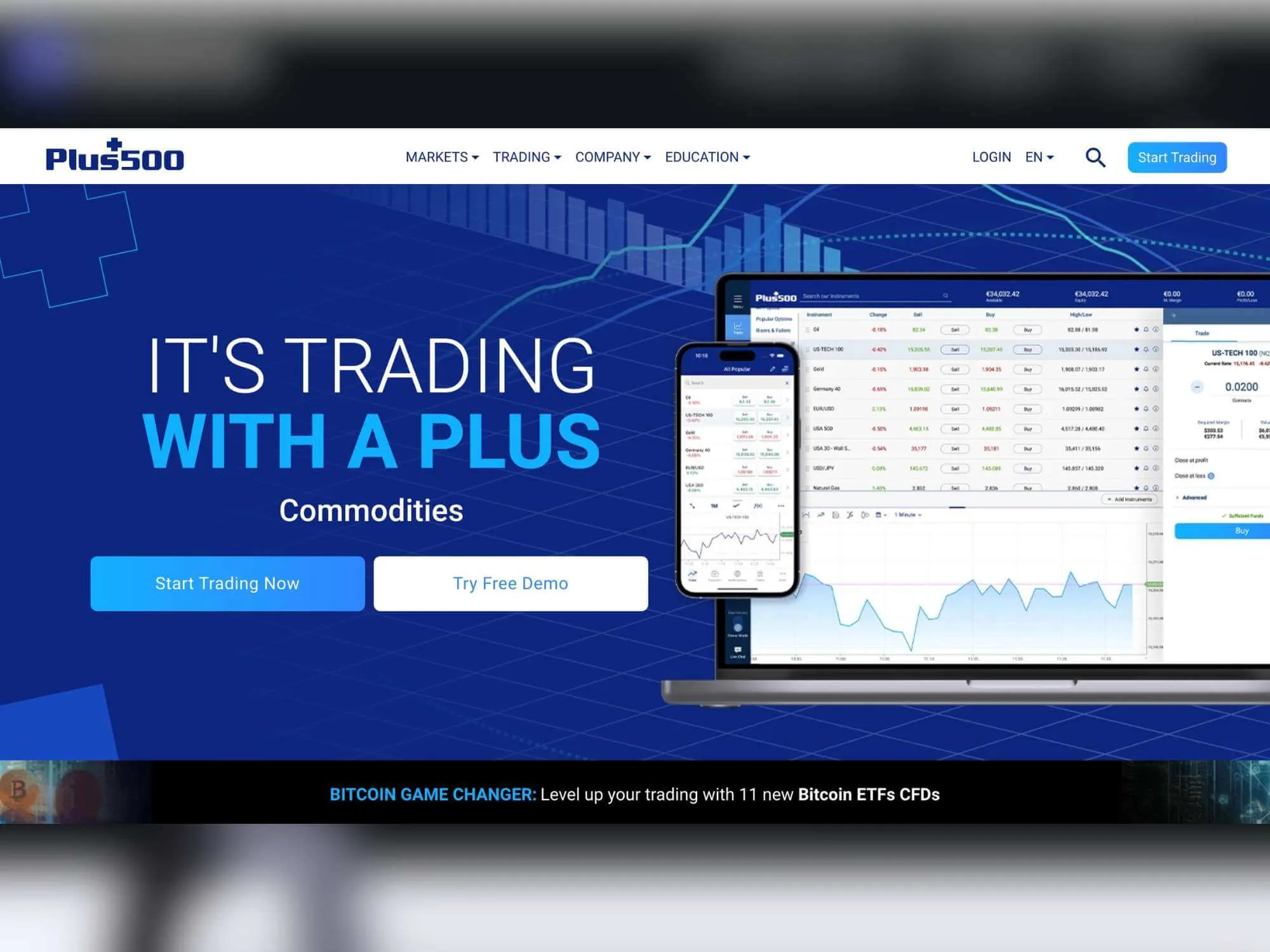
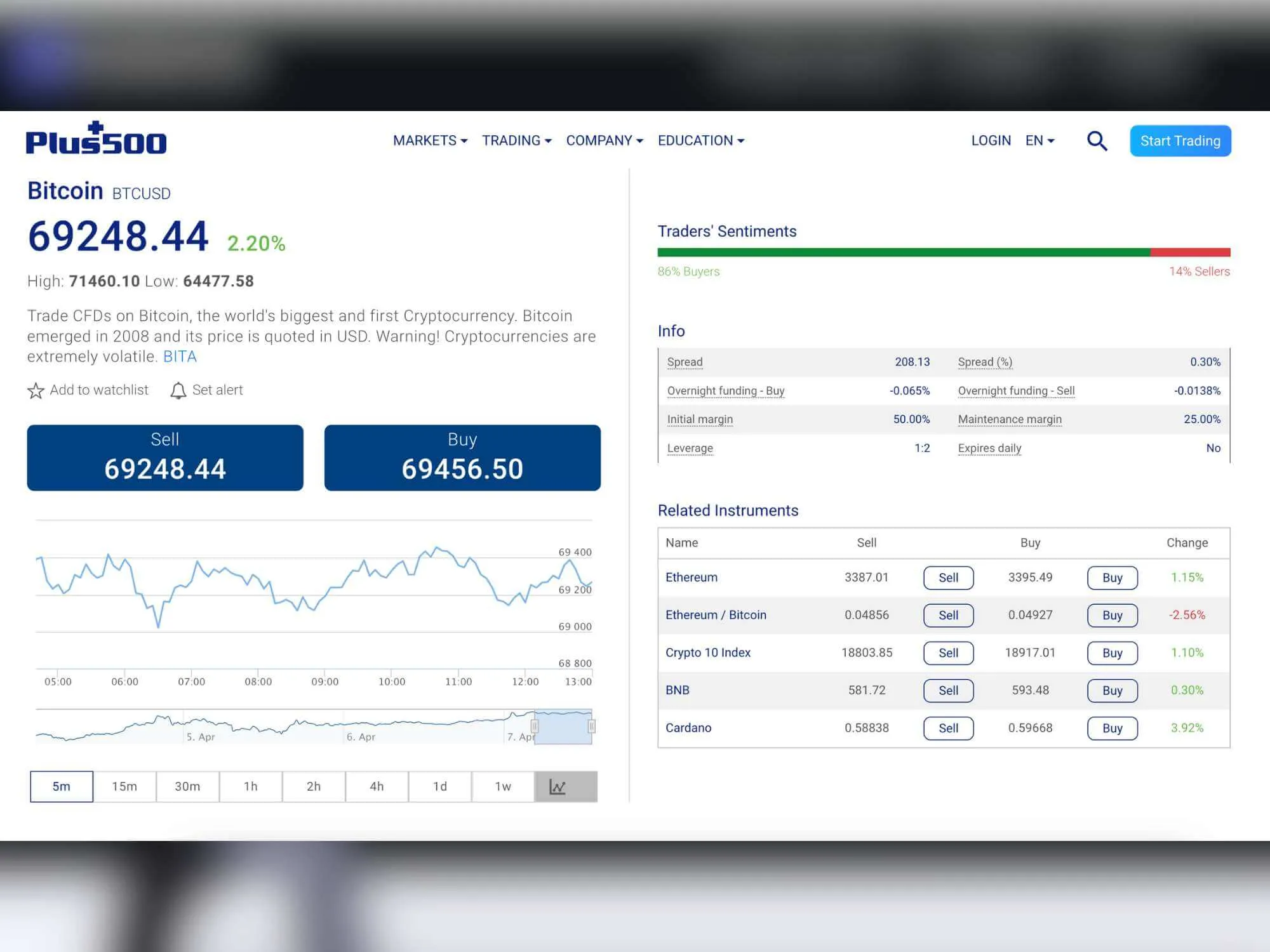
We rate the operation of Plus500 on the strength of its apps and its public instrument pages. The apps are well rated: 4.26 on the German App Store from 8,471 ratings and 4.3 on Google Play. Each instrument page shows the current spread, the overnight funding rates, the margin and the leverage without a login, and Bitcoin CFDs trade around the clock and on weekends, except for one hour on Sundays. What holds the score back in our view: prices on the public pages are delayed, the minimum deposit for your payment method appears only in the deposit screen, and US customers use a separate app.
We rate the range of functions highly for a CFD broker. In the EEA you can go long or short on 24 cryptocurrencies, two crypto indices and an Ether/Bitcoin pair, next to share CFDs and forex, with up to 1:2 leverage on crypto. For risk control, Plus500 offers an optional stop order that closes at your exact requested rate in exchange for a wider spread. Beyond crypto, the EEA instrument list covers CFDs on indices, forex, commodities, shares, options and ETFs, so one account reaches most major markets. In the US, the crypto offer is 9 micro futures, and the US platform also runs prediction markets.
We rate Plus500 well for beginners who want to learn CFD trading with small positions: you can practise first on a demo account with unlimited virtual funds, crypto leverage is capped at 1:2, and retail clients get negative balance protection. Plus500 also runs a trading academy that covers the basics of trading. Before your first trade, Plus500 verifies your identity and address and runs an appropriateness assessment; in our view, that check is a useful brake for newcomers. Keep the risk in mind, though: most retail CFD accounts lose money with this provider. If you are new to crypto and want to own your first coins, Coinbase is the simpler start in our view.

We rate fees and costs as average. Plus500 charges no commission to open or close a crypto CFD and no deposit or withdrawal fees in the EEA, which keeps the cost model short, and every instrument page lists its spread and overnight rates. Against that, the spread is the main cost and varies by coin, for example 0.15% on Bitcoin and 4.64% on Filecoin at our latest check, positions held overnight pay funding, conversion can cost up to 0.7% of the result, and an idle account pays up to USD 10 a month after three months without a login. In the US, crypto futures cost a commission of $0.49 per side on micro contracts instead.
We rate security and trust as good. Plus500 is regulated by CySEC in the EEA, keeps client money segregated, offers negative balance protection and belongs to the Investor Compensation Fund, which covers eligible claims up to the first EUR 20,000. The parent company, Plus500 Ltd in Haifa, Israel, is listed on the London Stock Exchange and part of the FTSE 250, and the group holds 17 licenses in 16 countries, including FCA authorization for Plus500UK Ltd and an ASIC license for Plus500AU Pty Ltd. Its US futures company is registered with the CFTC. The FCA register notes disciplinary or regulatory action involving Plus500UK Ltd.
We rate support on its reach and its written help. Plus500 offers 24/7 online chat, WhatsApp and a contact form. It publishes its fee rules, account terms and verification steps in a help center and a trading academy with FAQs, and the site for the EEA is also available in German. Plus500 does not list a phone line on its contact page. The contact form sorts requests by topic, such as deposits, withdrawals, account details, platform issues and trading, and lets you upload a file, such as a JPEG image or a PDF. In our view, chat around the clock covers most questions, but a phone line would help with urgent account problems.
In our view, Plus500 is a solid choice for traders in the EEA who want regulated, low-leverage crypto CFDs next to other markets, with regulation in several countries, negative balance protection and no commission on trades as its strengths. The costs to watch are overnight funding on positions you hold for longer and the inactivity fee. For long-term crypto investing, look at Kraken or Coinbase; if you want shares and real crypto in one app, see eToro.
About
Plus500
Plus500

Plus500 Review: Crypto CFDs, Fees, Regulation and Who It Suits

Our verdict: in our view, Plus500 is a CFD broker regulated by CySEC in the EEA that suits traders who want to speculate on crypto prices with modest leverage next to shares and forex, and a poor fit for anyone who wants to own crypto. Plus500 is a broker, not a crypto exchange: in the EEA, Plus500CY Ltd offers crypto only as contracts for difference, so you never hold the coins and cannot move them to a wallet.
Risk warning from Plus500: CFDs are complex instruments and come with a high risk of losing money rapidly due to leverage. 80% of retail investor accounts lose money when trading CFDs with this provider.
The crypto list covers 24 cryptocurrencies as CFDs, with leverage of up to 1:2 for retail clients in the EEA. There is no fee to open or close a trade. Plus500 earns mainly through the spread built into its prices.
Plus500 suits you if:
- you live in the EEA outside Belgium and want short-term exposure to Bitcoin, Ether and other large coins, long or short, without managing a wallet.
- you want crypto, shares and forex on one regulated platform with negative balance protection.
- you prefer a broker group that is listed on the London Stock Exchange and holds 17 licenses in 16 countries.
Plus500 is probably not for you if:
- you want to build a long-term crypto portfolio: the alternatives below suit that goal better.
- you live in the US: the CFD service excludes US residents, and US customers get crypto futures from a separate company instead.
- you mainly want to trade smaller coins cheaply: spreads vary by coin, for example 0.15% on Bitcoin and 4.64% on Filecoin at our latest check.
We rate Plus500 higher for beginner friendliness and functions than for operation and fees. If you want to own crypto, the alternatives below cover Coinbase, Kraken and eToro.
| Crypto Exchange | Cryptos | Trading Fee | Withdrawal Fee | For US Users? | EF Score |
|---|---|---|---|---|---|
 WEEX | 1173 | 0.1 % | ₿ 0.00016 | No |  9.8 /10 |
 MEXC | 1262 | 0.05 % | ₿ 0.00002 | No | 9.6 /10 |
 Binance | 416 | 0.1 % | VariesBinance sets this fee itself and adjusts it to activity on the Bitcoin network. On 2026-10-03 it charged 0.00002 BTC for a Bitcoin network withdrawal, about $1.69 at Binance's BTC/USDT price. | No | 9.4 /10 |
 OKX | 304 | 0.35OKX US entry tier (OKX INC.) for US residents. The global and EEA entry tier is 0.08% maker and 0.10% taker. % | VariesOKX charges the Bitcoin network fee it shows on its withdrawal page, and the amount changes with network load. On 2026-10-05 it showed 0.000015 BTC, about $1.29 at the OKX BTC index price. | Yes | 9.3 /10 |
 Bitpanda | 568 | 0.99 % | VariesBitpanda adjusts this fee to congestion on the Bitcoin network and says it earns nothing from it. On 2026-10-03 it showed 0.00000598 BTC, about $0.51 at Bitpanda's BTC price. | No | 9.2 /10 |
 KuCoin | 837 | 0.1 % | ₿ 0.00009 | No | 8.9 /10 |
 Bitvavo | 426 | 0.25 % | VariesBitvavo sets this fee itself and changes it with blockchain capacity. On 2026-10-03 it charged 0.000017 BTC, about $1.44 at Bitvavo's BTC/USDC price. | No | 8.8 /10 |
 eToro | 150 | 1 % | VariesMoving BTC from your eToro investment account to the eToro crypto wallet costs 2% of the amount (at least $1, at most $100). Sending it from the wallet to an external address then costs only the Bitcoin network fee. | Yes | 8.8 /10 |
 Kraken | 629 | 0.8 % | VariesKraken may adjust this fee as its costs and market conditions change. On 2026-10-03 its fee page showed 0.000015 BTC for a Bitcoin withdrawal when viewed from the US. | Yes | 8.8 /10 |
 Pionex | 311 | 0.05 % | ₿ 0.000018 | No | 8.5 /10 |
 Bybit | 393 | 0.1 % | VariesBybit sets this fee itself and changes it often. Between 2026-10-02 and 2026-10-05 it showed 0.000035 to 0.000068 BTC for a Bitcoin network withdrawal. | No | 8.5 /10 |
 Coinbase | 407 | 0.9Coinbase Advanced spot entry tier for US residents. In the EU and UK the entry tier is 0.25% maker and 0.50% taker; in Brazil, India and other international markets it is 0.09% maker and 0.10% taker. % | VariesCoinbase sets this fee from its own estimate. Estimated Bitcoin network cost on 2026-10-03: about $0.36 (range $0.12 to $0.83 over the previous 24 hours, mempool.space). | Yes | 8.3 /10 |
 BSDEX | 10 | 0.35 % | ₿ 0 | No | 8.2 /10 |
 Bitfinex | 68 | 0 % | ₿ 0.00006 | No | 8.1 /10 |
 Bitstamp | 114 | 0.4 % | VariesBitstamp charges its own estimate of the Bitcoin network fee plus a processing fee it does not publish, and shows the total before you confirm. Estimated network cost on 2026-10-03: about $0.36 (range $0.12 to $0.83 over the previous 24 hours, mempool.space); the processing fee comes on top. | Yes | 8.1 /10 |
 Bitget | 511 | 0.1 % | ₿ 0.00002 | No | 8 /10 |
 justTRADE | 73 | 0.125justTRADE charges no maker or taker fees. You pay a 0.125% commission per crypto order plus a spread of at least 0.175% in the price. % | Not possiblejustTRADE does not allow transfers of crypto into or out of your account. | No | 8 /10 |
 Crypto.com | 416 | 0.5 % | VariesCrypto.com Exchange quotes 0.0004 BTC for a Bitcoin withdrawal, about $33.82 at its BTC price on 2026-10-03. The quote is based on an estimate of network fees, so the final fee may differ. | Yes | 8 /10 |
 Trade Republic | 50 | 0Trade Republic charges no commission on crypto trades. You pay a €1 settlement fee per trade, plus a spread in the price. % | VariesTrade Republic charges no fee to send crypto; you pay only the Bitcoin network fee. Estimated network cost on 2026-10-03: about $0.36 (range $0.12 to $0.83 over the previous 24 hours, mempool.space). | No | 7.9 /10 |
 Phemex | 139 | 0.1 % | ₿ 0.000015 | No | 7.8 /10 |
 Scalable Capital | 32 | 1% % | Not possibleScalable Capital holds crypto as exchange-traded products (ETPs), not as coins, so you cannot withdraw it to a private wallet. In exceptional cases an ETP issuer may redeem the coins to your own wallet, with its own checks and fees. | No | 7.8 /10 |
 CEX.IO | 272 | 0.25 % | VariesCEX.IO lists this fee as floating and sets the amount itself. On 2026-10-03 it listed 0.000075 BTC, about $6.35 at CEX.IO's BTC price. | Yes | 7.5 /10 |
 Relai | 1 | 1Relai charges a 1.00% service fee on transactions of €50 to €99,999.99, plus its own margin in the price. % | No feeRelai's wallet is non-custodial, so the bitcoin you buy is held in your own wallet. Relai covers the Bitcoin network fee when you buy; when you sell, the network fee is included in the price shown. | No | 7.5 /10 |
Plus500 | 24 | 0Plus500 offers crypto as CFDs in the EEA. It charges no fee to open or close a trade and is paid mainly through the spread built into its quoted price. % | Not possiblePlus500 offers crypto as CFDs, so there are no coins to withdraw. | No | 7.5 /10 |
 WhiteBIT | 338 | 0.1 % | VariesWhiteBIT bases this fee on blockchain fees and the price of bitcoin, and it can change the fee without notice. On 2026-10-08 it listed 0.00009 BTC for a withdrawal on the Bitcoin network, about $7.48 at WhiteBIT's BTC price. | No | 7.4 /10 |
 Gate.io | 1464 | 0.1 % | VariesGate adjusts its withdrawal fees every hour based on network conditions. On 2026-10-04 its fee page showed 0.00003 BTC for a Bitcoin withdrawal, about $2.57 at Gate's BTC price. | No | 7.2 /10 |
 BitFlyer | 9 | 0.1bitFlyer USA entry tier for Lightning Spot; bitFlyer Europe also charges 0.10%. On bitFlyer USA, the Buy/Sell service has no separate fee, but its prices include a fee of 0.1% to 6.0%, and more when prices move sharply. % | ₿ 0.0004 | Yes | 7.1 /10 |
 Hotcoin | 285 | 0.2 % | ₿ 0.00003 | No | 7.1 /10 |
 bitcoin.de | 8 | 0.5 % | Variesbitcoin.de adjusts this fee regularly to the current Bitcoin network fee and keeps none of it. On 2026-10-22 its fee page showed 0.00000401 BTC, about $0.33 at Coinbase's BTC price. | No | 7 /10 |
 Gemini | 80 | 1.2 % | VariesGemini charges a dynamic fee meant to cover the Bitcoin network fee. Estimated network cost on 2026-10-03: about $0.36 (range $0.12 to $0.83 over the previous 24 hours, mempool.space). | Yes | 6.5 /10 |
 LBank | 885 | 0.1 % | ₿ 0.00005 | No | 6.3 /10 |
 Libertex | 102 | 0.1Libertex offers crypto only as CFDs. It charges a 0.1% commission on crypto CFDs, and the spread varies with the market. % | Not possibleLibertex offers crypto only as CFDs, so there are no coins to withdraw. | No | 6.1 /10 |
 Upbit | 360 | 0.05 % | ₿ 0.0002 | No | 6 /10 |
CFD risk warning: Libertex and Plus500 offer crypto as CFDs (contracts for difference), so you trade on the price without owning the coins. CFDs are complex instruments and come with a high risk of losing money rapidly due to leverage. Most retail investor accounts lose money when trading CFDs with these providers. You should consider whether you understand how CFDs work and whether you can afford to take the high risk of losing your money.
Plus500 at a glance
- Type: CFD broker in the EEA and futures broker in the US
- Operator in the EEA: Plus500CY Ltd, Limassol, Cyprus, authorized by CySEC (license 250/14)
- Group parent: Plus500 Ltd, Haifa, Israel, listed on the London Stock Exchange and part of the FTSE 250. Founded in 2008
- US company: Plus500US Financial Services LLC, a futures commission merchant registered with the CFTC (NFA ID 0001398)
- Licenses: 17 regulatory licenses across 16 countries
- Crypto CFDs in the EEA: 24 cryptocurrencies, or 27 crypto instruments when you count two crypto indices and an Ether/Bitcoin pair
- Crypto leverage for retail clients: up to 1:2
- Trading fees: no fee to open or close a trade. The spread is built into the quoted price
- Other costs: overnight funding, a currency conversion fee of up to 0.7% of realized profit or loss, and an inactivity fee of up to USD 10 a month after three months without a login
- Deposits and withdrawals: no fee from Plus500. Your bank or card issuer may charge
- Client protection: segregated client money, negative balance protection, Investor Compensation Fund cover of up to EUR 20,000 per eligible claim
- Spreads: shown on each public instrument page, for example 0.15% on Bitcoin at our latest check
- Trading hours: Bitcoin CFDs trade around the clock and on weekends, except for one hour on Sundays
- App ratings: 4.26 on the German App Store (8,471 ratings), 4.3 on Google Play
Where Plus500 offers crypto
Plus500 operates separate companies within each region, and the crypto product depends on your location. In the EEA, Plus500CY Ltd provides crypto CFDs to retail clients. Its user agreement excludes residents of Belgium. In Australia, Plus500AU Pty Ltd offers crypto CFDs under an ASIC license. Plus500UK Ltd, authorized by the FCA, does not offer crypto CFDs to retail clients in the UK.
Plus500 in the US
The CFD service is unavailable in the US, as the user agreement of Plus500CY Ltd excludes US residents and prohibits use from anywhere in the United States. Residents in the US can trade crypto through Plus500US Financial Services LLC, registered with the CFTC as a futures commission merchant. It offers 9 crypto micro futures, including Micro Bitcoin, Micro Ether, and Micro SOL. Trading privileges require review and approval. To buy and hold coins in the US, see our list of exchanges for US customers.
What Plus500 costs: a worked example
Plus500 charges no commission on crypto CFDs. Your costs arise from four sources:
- The spread: the difference between the buy and sell price, included in every quote. Plus500 lists the current spread on each public instrument page. Our latest check showed 0.15% for Bitcoin, 0.25% for Ether, and 1.78% for Solana, with figures adjusting to market conditions.
- Overnight funding: holding a position past the daily funding time results in an account adjustment. The rate appears on each instrument page. For Bitcoin, it was -0.06036% for buy positions and -0.01841% for sell positions at our latest check.
- Currency conversion: up to 0.7% of the realized profit or loss when trading in a currency other than your account currency.
- Inactivity: up to USD 10 per month after three months without a login.
Consider opening a long Bitcoin CFD (BTCUSD) from a euro account at the maximum leverage of 1:2. In Plus500's own example, €100 of margin provides the effect of €200 in capital, making each Bitcoin price move impact your margin twice as much. There is no commission for opening or closing. With a Bitcoin spread of 0.15%, the position opens with a small loss equal to the spread. Holding past the funding time incurs a buy rate of -0.06036% each night. Closing triggers a conversion fee of up to 0.7%, as the contract is priced in dollars. An optional stop order closing at your exact rate costs a wider spread.
In the US, the cost structure differs: Plus500US charges a commission of $0.49 per side on micro contracts, plus a $0.02 NFA fee per side and exchange fees, and $10 per contract if a position is liquidated. Deposits are free, with the first withdrawal of each calendar month also free. Subsequent withdrawals cost 1.75% (minimum $1, maximum $150).
In our view, the instrument page is worth a look before every trade. To see what spot exchanges charge, compare the cards on our fee comparison of crypto exchanges.
Security and regulation
Plus500CY Ltd is a Cyprus Investment Firm authorized by CySEC under license 250/14 and regulated as an investment firm under MiFID.
Client money is held in segregated bank accounts according to CySEC client funds rules. Negative balance protection is provided, and the Investor Compensation Fund covers eligible claims up to EUR 20,000.
The group has 17 licenses in 16 countries, including the UK, Australia, and Singapore. Plus500UK Ltd is authorized by the FCA (FRN 509909), and Plus500AU Pty Ltd holds an ASIC license (AFSL 417727). The US futures company is registered with the CFTC and is an NFA member.
The FCA register notes disciplinary or regulatory action involving Plus500UK Ltd. Proof of reserves does not apply here, because Plus500 does not hold crypto in custody for its clients.
Who should not use Plus500
Avoid Plus500 if you are unfamiliar with leverage and cannot afford fast losses, or if you want to invest in crypto long-term. For those objectives, one of the providers listed below may be more suitable. Our list of crypto brokers puts Plus500 next to eToro, Trade Republic, and other brokers.
Alternatives to Plus500
- Coinbase for beginners aiming to own coins, listing 407 crypto assets and available in the US.
- Kraken for active traders seeking real coins from an extensive list, offering 629 crypto assets and serving US residents, except in New York and Maine.
- eToro for those wanting shares and real crypto in one app: eToro (Europe) Ltd holds a MiCA authorization from CySEC, with US customers in most states trading crypto through eToro USA LLC.
For a side by side view of the two brokers, read eToro vs Plus500. How we score every provider is explained on How we rate.
FAQ
Is Plus500 a crypto exchange?
No, Plus500 is a CFD broker in the EEA and a futures broker in the US. Trading involves price movement speculation without owning the coins, meaning crypto cannot be withdrawn to a wallet.
Is Plus500 available in the US?
Only for futures. Crypto CFDs are unavailable to US residents, but Plus500US Financial Services LLC offers crypto micro futures to approved US customers. The US section above outlines the costs.
Is Plus500 regulated?
Yes, Plus500CY Ltd is authorized by CySEC, and the group holds 17 licenses in 16 countries.
How much do you need to start on Plus500?
In the EEA, minimum deposits differ per payment method and are shown on the platform's deposit screen. In the US, each deposit must be at least $10.
Does Plus500 charge withdrawal fees?
In the EEA, Plus500 charges no deposit or withdrawal fees, although your bank or payment provider might. In the US, the first withdrawal each calendar month is free, with subsequent transactions costing 1.75%, subject to a minimum of $1 and a maximum of $150.
About the author
Ethan Parker is Senior Content Editor at Exchange Flow. He has followed crypto since 2015, from Bitcoin and Ethereum to the exchanges people use to buy and trade them.
Compare
Plus500
Explore Other Crypto Exchanges
Compare Exchanges by Category









...