


Do you have ideas or suggestions for changes? Then we look forward to your feedback! We make every effort to keep all metrics and information as up-to-date as possible. However, if you discover an error or outdated information, we would be delighted to hear from you.
Feel free to write to us:

Transferable to your own wallet
Self-custody of cryptocurrencies plays an important role for many users who want to manage their cryptocurrencies and thus their "private keys" themselves and not leave them in the hands of the exchange. Most exchanges offer the option of sending the purchased cryptocurrencies to their own wallet.
Deposit protection is a safeguard for the assets of users of a stock exchange or broker, which is intended to protect investors in the event of insolvency or a high loss due to a hacker attack. Service providers based in Germany are legally obliged to provide deposit protection of €100,000. In some cases, international exchanges have a special insurance policy that covers a certain portion of the assets instead of a deposit guarantee.
The overall rating is the average of our individual ratings. Our ratings do not constitute investment advice, but merely our personal opinion. You are welcome to use them as rough indicators and additional perspective. In the dynamic and fast-growing crypto sector, parameters can often change from one day to the next, so we cannot guarantee that the rating data is up to date. Therefore, please never use our ratings as an isolated basis for decision-making and not as a substitute for your own research.
This rating describes our personal assessment of the user-friendliness of the product. How easy is the onboarding process? How modern is the user interface and is it easy to use? Are all the important functions quick and easy to find? We ask ourselves all these questions in order to give a personal rating from 1 to 10 points.
This rating describes our assessment of the fee structure of a stock exchange or broker. It is not only the amount of fees that can differ, but also the type of fees. The most common type of fees for crypto exchanges are the "maker/taker" fees or spreads. In some cases, there are also hidden fees that are not recognizable to users at first glance.
For products or services in the crypto space, trust and security should be the biggest factors in the selection process. Since we could not seriously evaluate the technical security of a platform or product, we analyze publicly available factors such as security features, location, regulation, certifications, audits, team/company, general reputation and, of course, track record.
Crypto doesn't have to be cryptic. Especially for beginners, the first contact with the crypto world can be overwhelming. With this rating, we give our assessment of how easy it is for beginners to find their way around: from the onboarding process to using the most important functions.
Customer support is an important factor for many users. A long wait or no response at all in the event of problems can be frustrating, especially when it comes to sensitive topics such as finances. With this rating, we give our assessment of the quality of customer support. In order to provide as balanced an assessment as possible, we also include user opinions from other platforms in our evaluation.
Some exchanges and brokers are regulated by financial supervisory authorities in certain countries/states. This often entails strict financial regulatory requirements and compliance requirements to which the company must adhere. Regulatory clarity can contribute to greater transparency and thus also greater trustworthiness.








Phemex vs Bybit in comparison
Overview

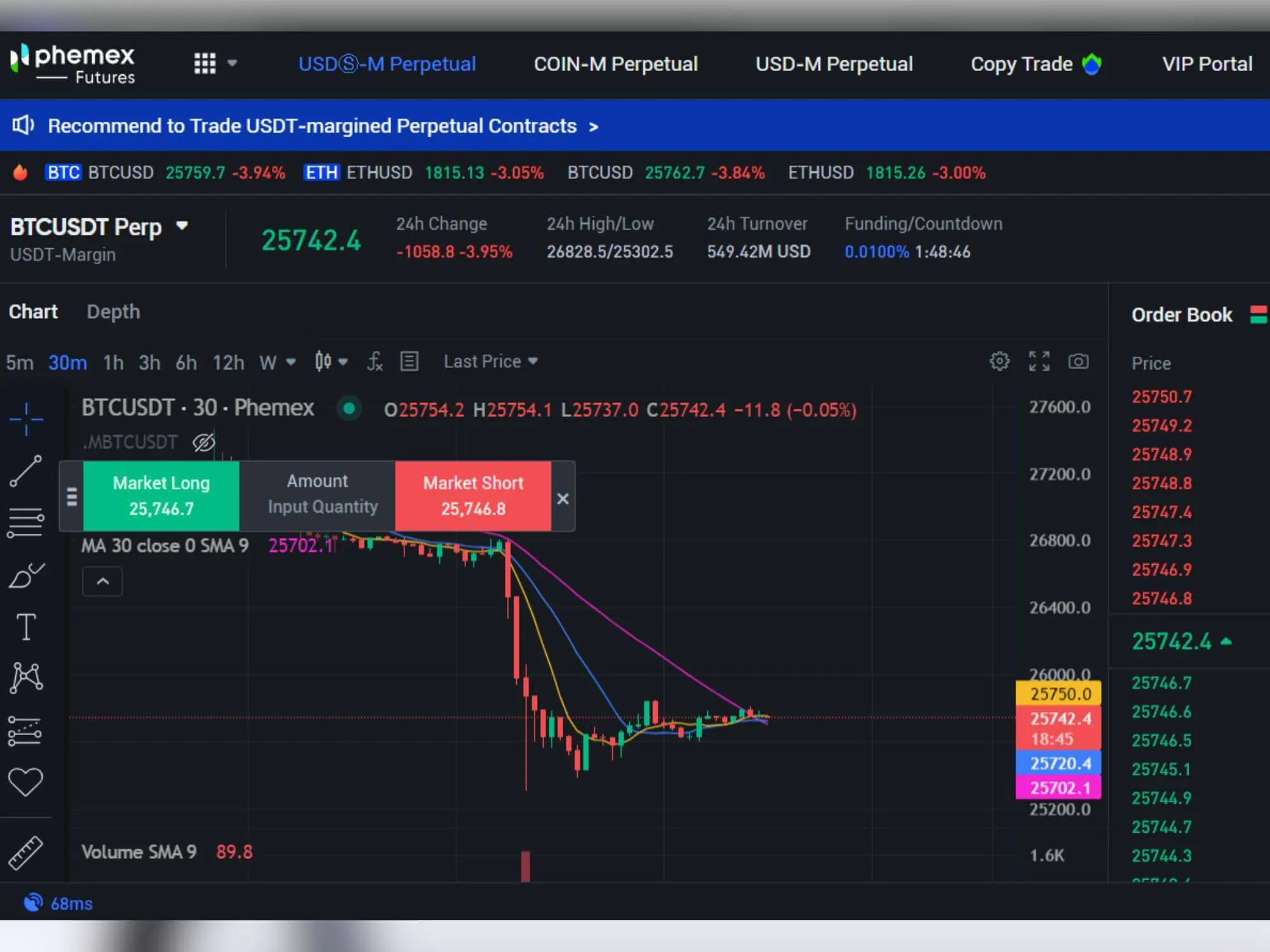
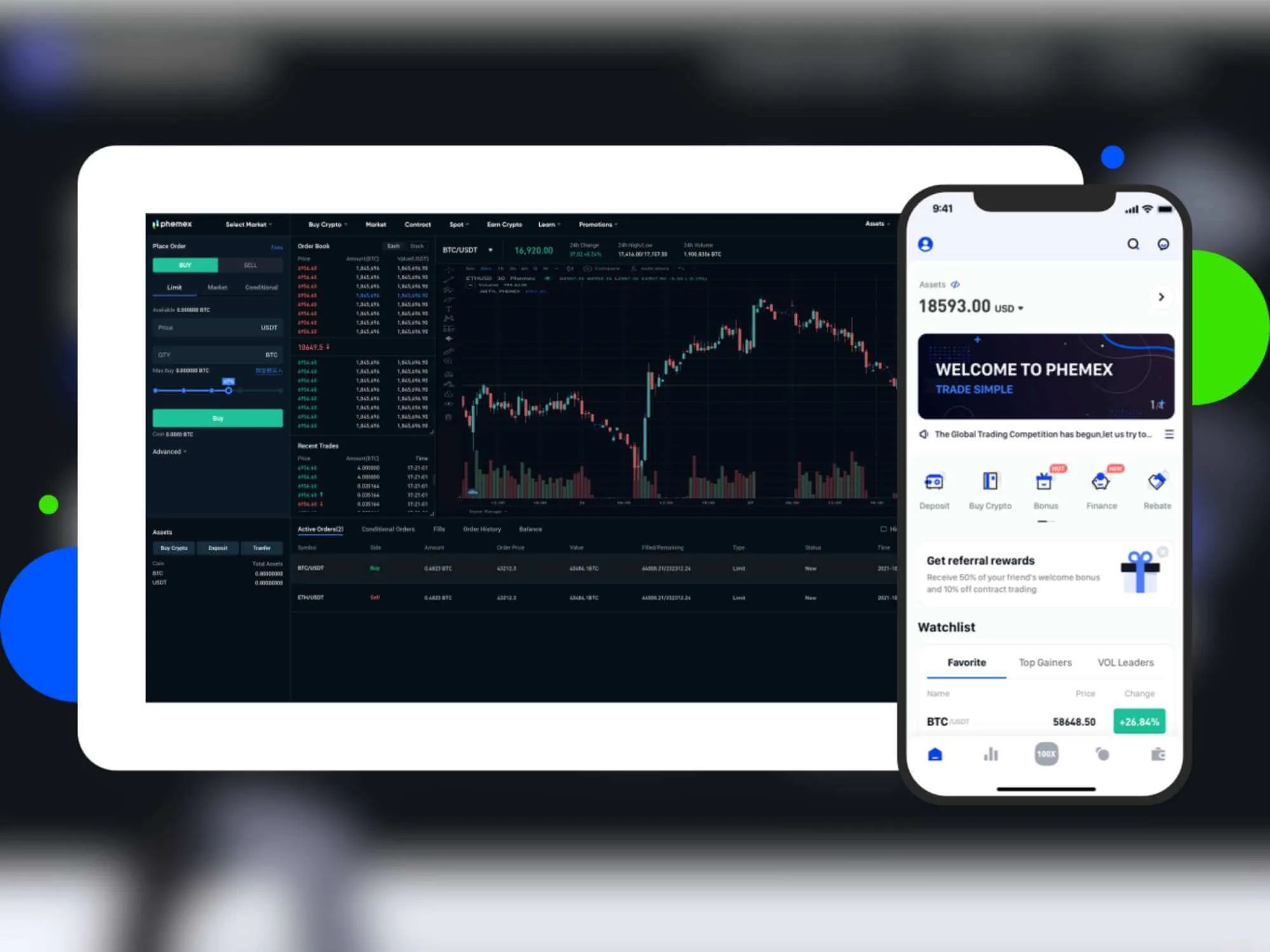
Phemex was founded in 2019 and says it has more than 10 million users. It lists 139 crypto assets by our count and 141 perpetual futures pairs, TradFi included, with up to 150x leverage. Spot trades cost 0.10% at the entry tier, futures 0.01% maker and 0.06% taker, and Phemex publishes a monthly proof of reserves.
- Low futures fees: 0.01% maker and 0.06% taker at the entry tier
- 141 perpetual futures pairs, TradFi included, with up to 150x leverage
- Grid, martingale and AI trading bots, plus copy trading
- Monthly proof of reserves with a check of your own balance
- Fixed Bitcoin withdrawal fee of 0.000015 BTC
- Not available in the US, the United Kingdom and four Canadian provinces
- No license; AML registrations only
- Permanently banned from trading in Ontario, and on the warning lists of the UK FCA and Singapore's MAS
- Proof of reserves without a named auditor
- Mid-sized coin list of 139 crypto assets

- Clear trading view
- Large selection of trading tools
- Low fees
- Might be complex for beginners
- Global platform still under assessment by the Seychelles FSA
Features Comparison
- Cryptocurrencies
- Cryptocurrencies
0.1
%
0.10%
0.10%
₿
0.000015
0.1
%
0.10%
0.10%
Varies
139
+


$
25
393
+
$
1


Exchange Rating

Functions


- Spot, futures and margin trading
- Phemex Earn
- Launchpad
- Spot, derivatives, bot trading, and copy trading8
- Bybit Earn
- Launchpad
Company Details

Our Review
In our view, Phemex is a good fit for active traders: 141 perpetual futures pairs, TradFi included, with up to 150x leverage, entry-tier futures fees of 0.01% maker and 0.06% taker, a 0.10% spot fee, trading bots and copy trading. A monthly proof of reserves adds transparency, and the coin list, at 139 crypto assets, is mid-sized.
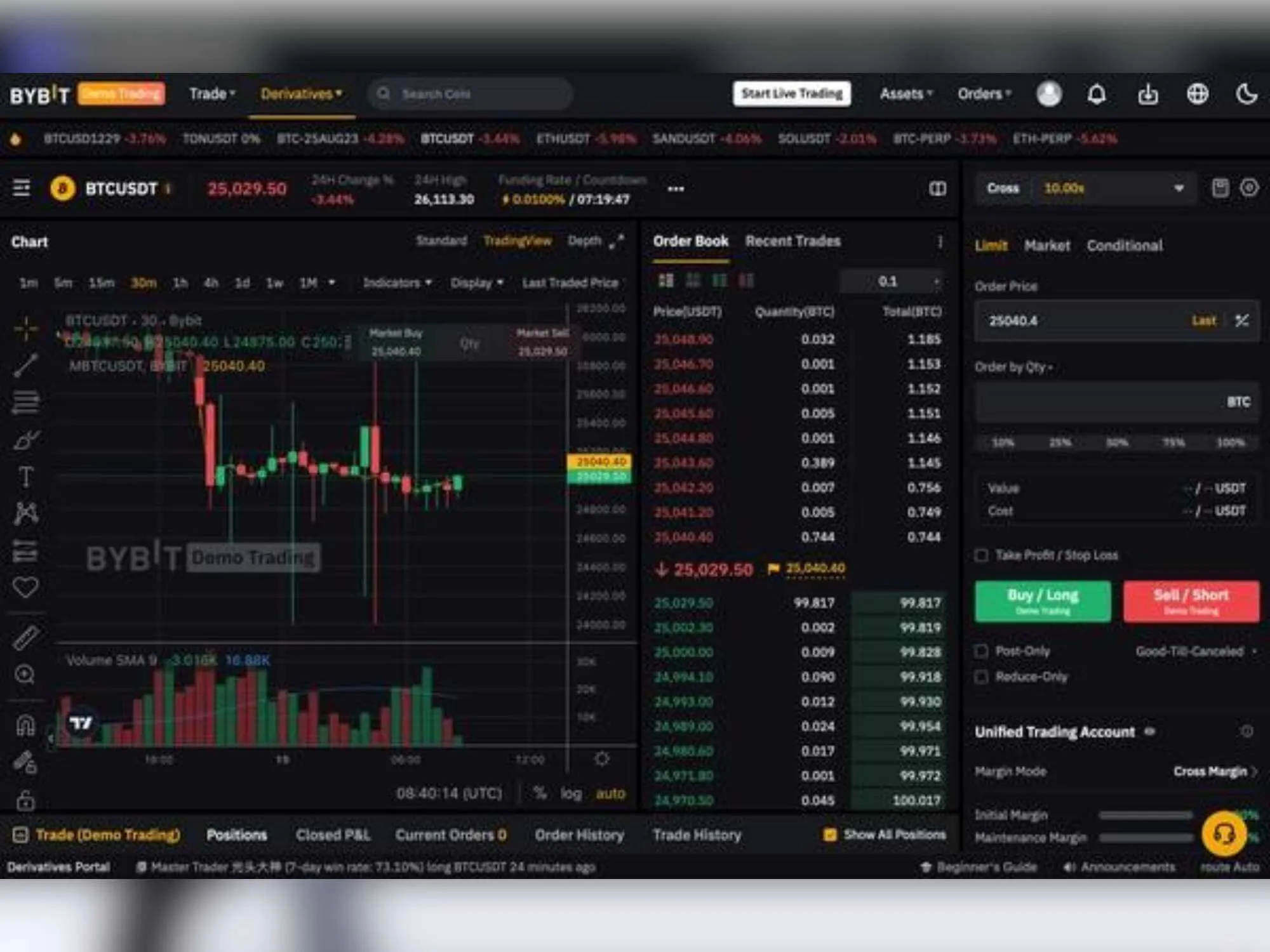
Bybit is a top platform for advanced traders, offering extensive derivatives and leveraged trading options with competitive fees. It excels in security and user experience but may be complex for beginners due to its advanced features. Geographical restrictions, particularly in the U.S., limit access, and withdrawal fees can vary. Overall, Bybit is well-suited for experienced traders looking for sophisticated tools and high-risk trading opportunities, but beginners should approach with caution.

Two Low-Fee Derivatives Platforms
Phemex and Bybit are both geared toward futures traders, with neither accepting customers from the US. In our view, Phemex is the better pick if you mostly place limit orders on perpetual futures, given its maker fee begins at 0.01% compared to 0.02% at Bybit. On the other hand, Bybit would be the better choice if you are interested in options, a significantly broader coin list, or an exchange in the EEA that is authorized under MiCA. Overall, we rate Bybit higher, with Phemex receiving a slightly better score in terms of fees.
Trading fees
On spot trades, both platforms charge 0.10% maker and 0.10% taker fees at their global entry level. The distinction emerges in futures trading. Phemex applies a 0.01% maker and 0.06% taker fee for perpetual contracts, whereas Bybit charges 0.02% maker and 0.055% taker. If your strategy involves mainly adding liquidity with limit orders, Phemex presents a cost-effective choice. Conversely, if taking liquidity with market orders is your priority, Bybit offers a marginally better rate.
Both lower their rates through VIP levels that you reach either by trading volume or by the assets you hold. At Phemex's top level, Star VIP, spot trades cost 0.00% maker and 0.04% taker. At Bybit's Supreme VIP level, spot trades cost 0.030% maker and 0.045% taker. Bybit EU, the separate platform for the EEA, uses its own schedule with a spot rate of 0.25%. We rate Phemex a little ahead on fees and costs.
Buying crypto and withdrawals
Phemex handles crypto purchases using Visa and Mastercard, charging 0.08% for cards issued in the EEA and 2.8% with most other cards. It also accepts bank and wire transfers in several currencies through Legend Trading. At Bybit, card purchases via One-Click Buy are processed by third-party providers that determine their own fees, and its P2P market imposes no Bybit fee on buyers or sellers.
Phemex lists a fixed bitcoin withdrawal fee of 0.000015 BTC. Bybit also charges a fixed fee per coin and network that does not depend on the amount, and it adjusts the bitcoin fee from time to time. Both let you withdraw your coins to your own wallet once your identity is verified.
Coins, futures and other products
Bybit lists far more coins on its spot market than Phemex, so if you trade smaller tokens, Bybit is more likely to have them. Both offer spot margin, perpetual futures settled in USDT or USDC and coin-margined contracts. Phemex shows up to 150x on its perpetual futures, and Bybit's own data lists 150x for its BTCUSDT perpetual.
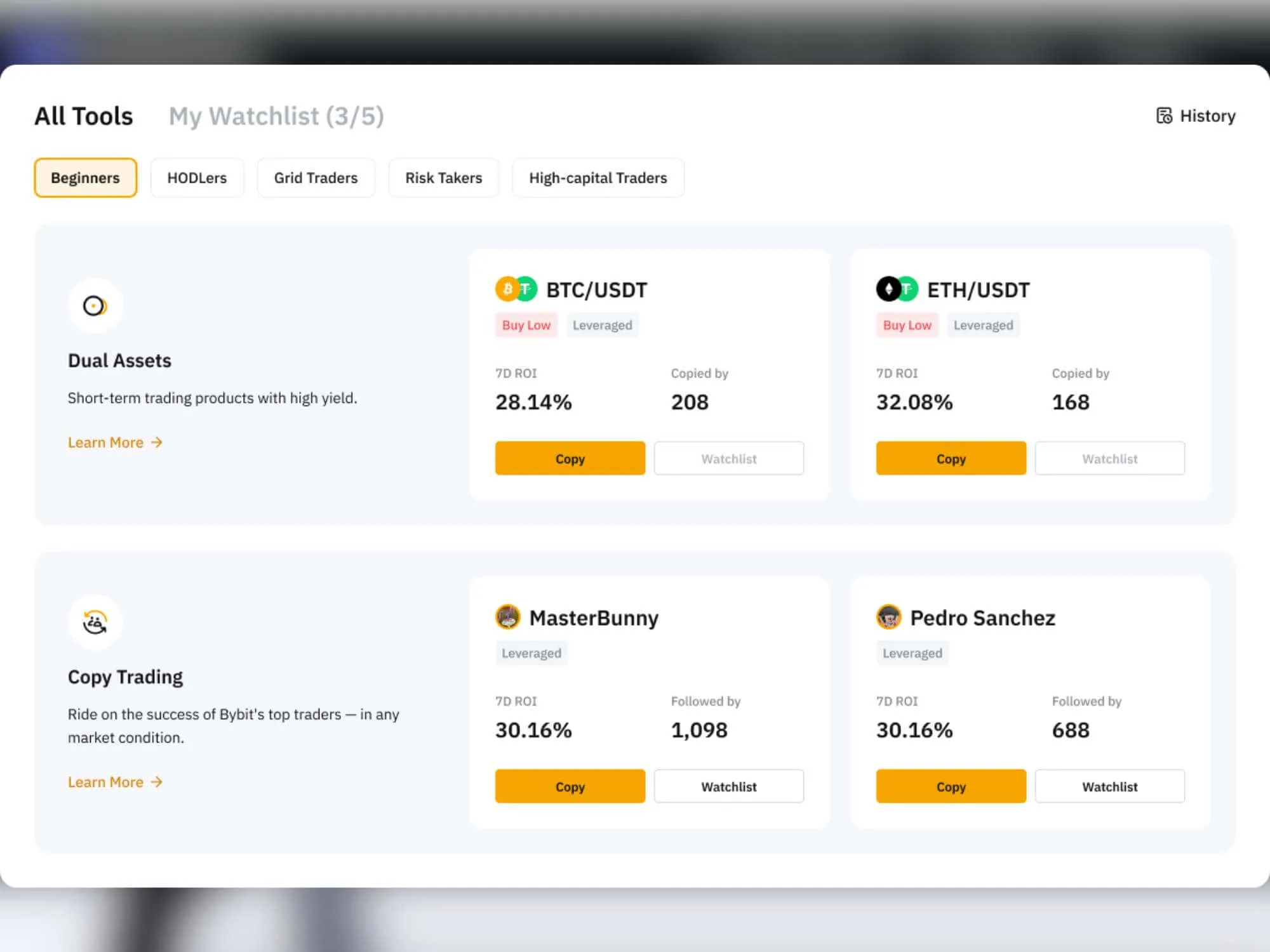
Bybit's range is wider. It adds dated futures, options, tokenized US stocks called xStocks on its spot market, CFDs through MetaTrader 5, a P2P market, Recurring Buy and Earn products such as Easy Earn, On-Chain Earn and Dual Asset. Phemex offers TradFi futures on stocks, metals, commodities, indices and forex, trading bots including an AI bot that suggests grid and martingale settings, Launchpool and a Phemex Card for EEA residents. Both offer copy trading and grid bots. We rate the two the same for range of functions.
Where you can use them
Neither exchange operates in the United States. Phemex identifies the US, United Kingdom, the United Arab Emirates, Australia, and Canadian provinces like Ontario, Québec, Alberta, and Saskatchewan as restricted regions, requiring users to confirm they are not US citizens or tax residents. Bybit excludes Australia, the United States, the Chinese Mainland, Hong Kong, Singapore, Canada, and France from its global platform, with exclusions based on nationality rather than residency.
In Europe the two differ most. Bybit EU GmbH in Vienna is authorized under MiCA by Austria's FMA, and that authorization covers every EEA country except Malta. Bybit also returned to the UK with spot trading and P2P. Phemex is not in ESMA's MiCA register. The entry of its Polish company in Poland's register of virtual currency activities is archived, and by the register's own note such an entry authorizes no crypto-asset services. The FCA lists Phemex as a firm that is not authorized in the UK.
Security and track record
We rate both the same for security and trust, and both lost money to hackers in 2025. In January 2025, attackers hit Phemex's hot wallets; Phemex says its cold wallets were untouched and that it covered all user losses from company reserves. In February 2025, about $1.5 billion in virtual assets was stolen from Bybit, and the FBI attributed the theft to North Korea. Bybit's next proof-of-reserves snapshot showed ETH reserves at 102% of user ETH.
Both publish proof-of-reserves reports based on a Merkle tree, and Phemex says it keeps over 70% of user assets in cold wallets. Bybit completed a SOC 2 Type II audit by Deloitte and holds ISO/IEC 27001 certification. On the regulatory side, Bybit holds licenses in the UAE and Kazakhstan next to its MiCA authorization, while Phemex names no financial license. Regulators have acted against both: Ontario's Capital Markets Tribunal ordered Phemex to pay a $300,000 penalty, Singapore's MAS has Phemex on its Investor Alert List, India's FIU fined Bybit, and France's AMF has had Bybit on its blacklist since 2022.
Neither offers deposit insurance. Bybit's terms say digital assets it holds for you are not insured by any government authority.
Ease of use and support
We rate both the same for operation and beginner friendliness, and both screens are built around futures, which can overwhelm a first-time buyer. Phemex offers a demo trading mode with play money and says verification usually takes 2 to 5 minutes. Bybit says its verification takes about 15 minutes, though it can take up to 48 hours. Identity verification is mandatory at Bybit, and at Phemex you cannot withdraw without it.
We rate Bybit slightly higher for support. Phemex advertises 24/7 live chat and a ticket form, and Bybit answers support cases by email, within one working day for verification issues.
Our verdict by criterion
Overall we rate Bybit higher. Phemex wins on fees for maker orders on futures, while Bybit offers options, more coins and a MiCA-authorized platform in the EEA.
- Fees and costs: we rate Phemex slightly higher
- Range of functions: we rate them the same
- Operation: we rate them the same
- Beginner friendliness: we rate them the same
- Security and trust: we rate them the same
- Support: we rate Bybit slightly higher
Which one fits you
- Futures traders who place limit orders would find Phemex more beneficial due to the lower maker fee.
- Traders seeking options, more coins, or tokenized stocks should consider Bybit.
- Readers in the EEA who want a MiCA-authorized exchange: Bybit, through Bybit EU.
- Beginners primarily interested in buying and holding might find neither platform ideal. Coinbase vs Phemex points to a simpler option.
For the details, read our Phemex review and our Bybit review, or compare OKX vs Bybit. Our list of exchanges for derivatives has more choices, and readers in the US can turn to our list of crypto exchanges for US customers.
Questions about Phemex and Bybit
Is Phemex better than Bybit?
In our view, Phemex is better only for futures traders who mostly place limit orders, thanks to its 0.01% maker fee. Bybit offers more products and coins and a MiCA-authorized platform in the EEA, and we rate it higher overall.
Are Phemex and Bybit available in the US?
No, both exchanges list the United States as a restricted or excluded area. Phemex also excludes US citizens and tax residents.
Which has lower futures fees, Phemex or Bybit?
Phemex is more cost-effective for maker orders at 0.01% compared to Bybit's 0.02%. For taker orders, Bybit offers a slightly better rate at 0.055% against 0.06% at Phemex.
About the author
At Exchange Flow, Ethan is recognized as the resident crypto expert. With 10+years of experience navigating the waters of global crypto exchanges, Ethan is a trusted voice in the ever-evolving world of digital currencies. He tests and scrutinizes exchanges so you don’t have to, offering reviews and articles that newbies and seasoned traders alike find invaluable. When he’s not coding, Ethan likes to travel and play retro games. He uses his crypto earnings to fund his trip around the globe.