


Do you have ideas or suggestions for changes? Then we look forward to your feedback! We make every effort to keep all metrics and information as up-to-date as possible. However, if you discover an error or outdated information, we would be delighted to hear from you.
Feel free to write to us:

Transferable to your own wallet
Self-custody of cryptocurrencies plays an important role for many users who want to manage their cryptocurrencies and thus their "private keys" themselves and not leave them in the hands of the exchange. Most exchanges offer the option of sending the purchased cryptocurrencies to their own wallet.
Deposit protection is a safeguard for the assets of users of a stock exchange or broker, which is intended to protect investors in the event of insolvency or a high loss due to a hacker attack. Service providers based in Germany are legally obliged to provide deposit protection of €100,000. In some cases, international exchanges have a special insurance policy that covers a certain portion of the assets instead of a deposit guarantee.
The overall rating is the average of our individual ratings. Our ratings do not constitute investment advice, but merely our personal opinion. You are welcome to use them as rough indicators and additional perspective. In the dynamic and fast-growing crypto sector, parameters can often change from one day to the next, so we cannot guarantee that the rating data is up to date. Therefore, please never use our ratings as an isolated basis for decision-making and not as a substitute for your own research.
This rating describes our personal assessment of the user-friendliness of the product. How easy is the onboarding process? How modern is the user interface and is it easy to use? Are all the important functions quick and easy to find? We ask ourselves all these questions in order to give a personal rating from 1 to 10 points.
This rating describes our assessment of the fee structure of a stock exchange or broker. It is not only the amount of fees that can differ, but also the type of fees. The most common type of fees for crypto exchanges are the "maker/taker" fees or spreads. In some cases, there are also hidden fees that are not recognizable to users at first glance.
For products or services in the crypto space, trust and security should be the biggest factors in the selection process. Since we could not seriously evaluate the technical security of a platform or product, we analyze publicly available factors such as security features, location, regulation, certifications, audits, team/company, general reputation and, of course, track record.
Crypto doesn't have to be cryptic. Especially for beginners, the first contact with the crypto world can be overwhelming. With this rating, we give our assessment of how easy it is for beginners to find their way around: from the onboarding process to using the most important functions.
Customer support is an important factor for many users. A long wait or no response at all in the event of problems can be frustrating, especially when it comes to sensitive topics such as finances. With this rating, we give our assessment of the quality of customer support. In order to provide as balanced an assessment as possible, we also include user opinions from other platforms in our evaluation.
Some exchanges and brokers are regulated by financial supervisory authorities in certain countries/states. This often entails strict financial regulatory requirements and compliance requirements to which the company must adhere. Regulatory clarity can contribute to greater transparency and thus also greater trustworthiness.









Kraken vs Crypto.com in comparison
Overview

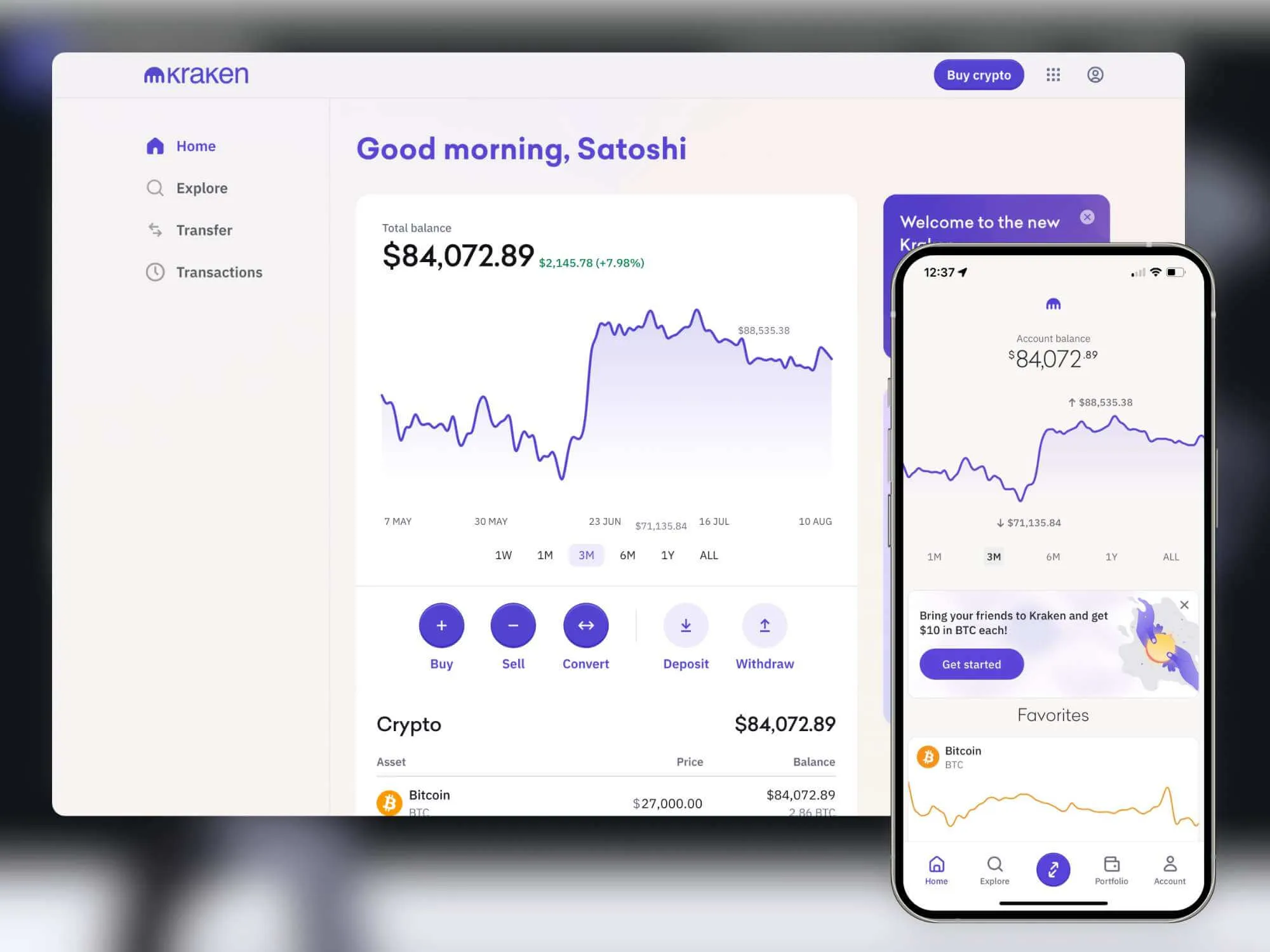
Kraken is a cryptocurrency exchange that was established in 2011 and is operated by Payward, Inc., a Delaware corporation. It holds licenses or registrations in the US, the EU, the UK, Canada, and Australia, with MiCA authorization in the EU through the Central Bank of Ireland. The exchange's Wyoming bank, Kraken Financial, was granted its charter in 2020.

Crypto.com was founded in 2016. It serves US customers mainly through Foris DAX, Inc., a Delaware corporation, and customers in the EEA through Foris DAX MT Limited in Malta, which holds a MiCA license from the MFSA. Its App covers buying, selling, staking, cards and, in the US, stocks, and the Crypto.com Exchange is its order book.
- Licensed or registered in the US, the EU, the UK, Canada, and Australia
- Proof of reserves from 100.3% to 102.9% for BTC, ETH, SOL, XRP, and ADA (30 June 2026)
- Kraken Pro fees decrease with 30-day volume or balance, to 0% maker
- Free ACH and SEPA deposits starting at 1 USD or 1 EUR
- Staking, stocks, and some transfers vary by US state
- No insurance on crypto holdings
- Entry tier 0.40% maker and 0.80% taker. App instant buys 1% plus spread
- Debit card deposits cost $0.25 plus 3.75%
- Available in 49 US states, Washington, DC and the US territories
- Exchange spot fees from 0.25% maker and 0.50% taker, lower with volume or a CRO balance
- More than 12,000 commission-free stocks and ETFs for US customers
- MiCA license in the EEA through the MFSA
- No Crypto.com fee on ACH deposits from 1 USD
- Not available in New York
- App trades cost 0.8% plus a possible spread without a paid Level Up plan
- Bitcoin withdrawals cost 0.0004 BTC on the Exchange
- Latest published proof of reserves covers balances as of December 7, 2022
- Two separate apps with different fee models
Features Comparison
- Cryptocurrencies
- Derivatives
- Cryptocurrencies
0.8
%
0.80%
0.40%
Varies
0.5
%
0.50%
0.25%
Varies
629
+


$
1
416
+
$
1


- Cashback program
- Discount on fees
- Earn interest through staking
- Further advantages & features
Exchange Rating

Functions


- Margin trading with up to 10x leverage
- Copy trading
- Crypto.com Visa Card
- Earn interest on crypto
- NFT marketplace
Company Details

Our Review
Kraken suits traders in most US states, the EU, the UK, Canada, and Australia who seek a long-running, licensed exchange with order-book trading and proof of reserves. Kraken Pro begins at 0.40% for makers and 0.80% for takers, with fees decreasing as trading volume increases, while instant buys in the app incur a cost of 1% plus a spread. In our view, Coinbase may be preferable for new users.
Crypto.com suits buyers in 49 US states, Washington, DC and the US territories, the EEA and the UK who want crypto, a card and, in the US, stocks in one app. Its Exchange starts at 0.25% maker and 0.50% taker; App trades carry 0.8% plus a possible spread. In our view, active traders should look at Kraken, and New York residents at Coinbase.

Kraken vs Crypto.com: Fees, Coins and US Availability
In our view, Kraken is the better option for most active traders within the US: we rate it higher overall, Kraken Pro provides spot margin to eligible US clients, and its Bitcoin withdrawal fee is significantly lower. If your priority is the lowest entry-level order-book fees, Crypto.com is the better choice. Its Exchange charges 0.25% to makers and 0.50% to takers at the initial level, while Kraken Pro starts at 0.40% and 0.80%. Both platforms serve most of the US, but Kraken does not accept residents of New York or Maine, and Crypto.com keeps its app unavailable in New York.
Trading fees
At the initial level, the Crypto.com Exchange offers lower fees: 0.25% for makers and 0.50% for takers while your 30-day spot volume remains below $10,000, compared to 0.40% for makers and 0.80% for takers on the first tier of Kraken Pro. As trading volume increases, the fee difference decreases. From $10,000 in 30-day volume, Crypto.com charges 0.20% and 0.40%, while Kraken charges 0.22% and 0.38%. Kraken considers the assets you hold with it for tier calculation. In contrast, Crypto.com ties its discount to the CRO token, and holding 50,000 CRO or more on the Exchange cuts the maker fee to zero.
Simple purchases incur higher costs on both platforms. Kraken applies 1% on instant and recurring purchases, with a spread included in the quoted price. In the Crypto.com App, an admin fee may apply, determined by market conditions, and the trade preview displays it before confirmation. Kraken+ waives the Kraken fee on up to $10,000 a month of buys, sells, and converts in the Kraken app for $4.99 a month, and Crypto.com highlights zero trading fees as a perk of its Level Up plans. In our view, the order book is the better-value route on both platforms.
Withdrawals and deposits
Bitcoin withdrawals are considerably cheaper on Kraken, which lists a fee of 0.000015 BTC and notes that withdrawal fees may vary. On the Crypto.com Exchange, the quoted fee is 0.0004 BTC on the Bitcoin network, an estimate subject to change during network congestion. Both platforms accept ACH deposits for US dollars without a platform fee, although Crypto.com users may incur a bank charge. A debit card deposit on Kraken incurs a $0.25 fee plus 3.75%.
Where you can use them
Kraken does not serve residents of New York or Maine. Crypto.com's app is available in 49 states, plus the District of Columbia and the US territories, with New York as the exception, meaning Maine residents can access Crypto.com but not Kraken, and New York residents have access to neither. Coinbase holds a New York license from NYDFS and is included in our Coinbase review.
Staking availability varies by state on both platforms. Kraken provides on-chain staking only in its supported states, excluding California and Texas, among others. Crypto.com's states where staking is not available include California, Maryland, New Jersey, and Wisconsin, so Texas residents can stake on Crypto.com but not Kraken. Kraken offers US stocks and ETFs in select states, and Crypto.com's broker-dealer, Foris Capital US LLC, provides more than 12,000 stocks and ETFs to US customers.
Coins and products
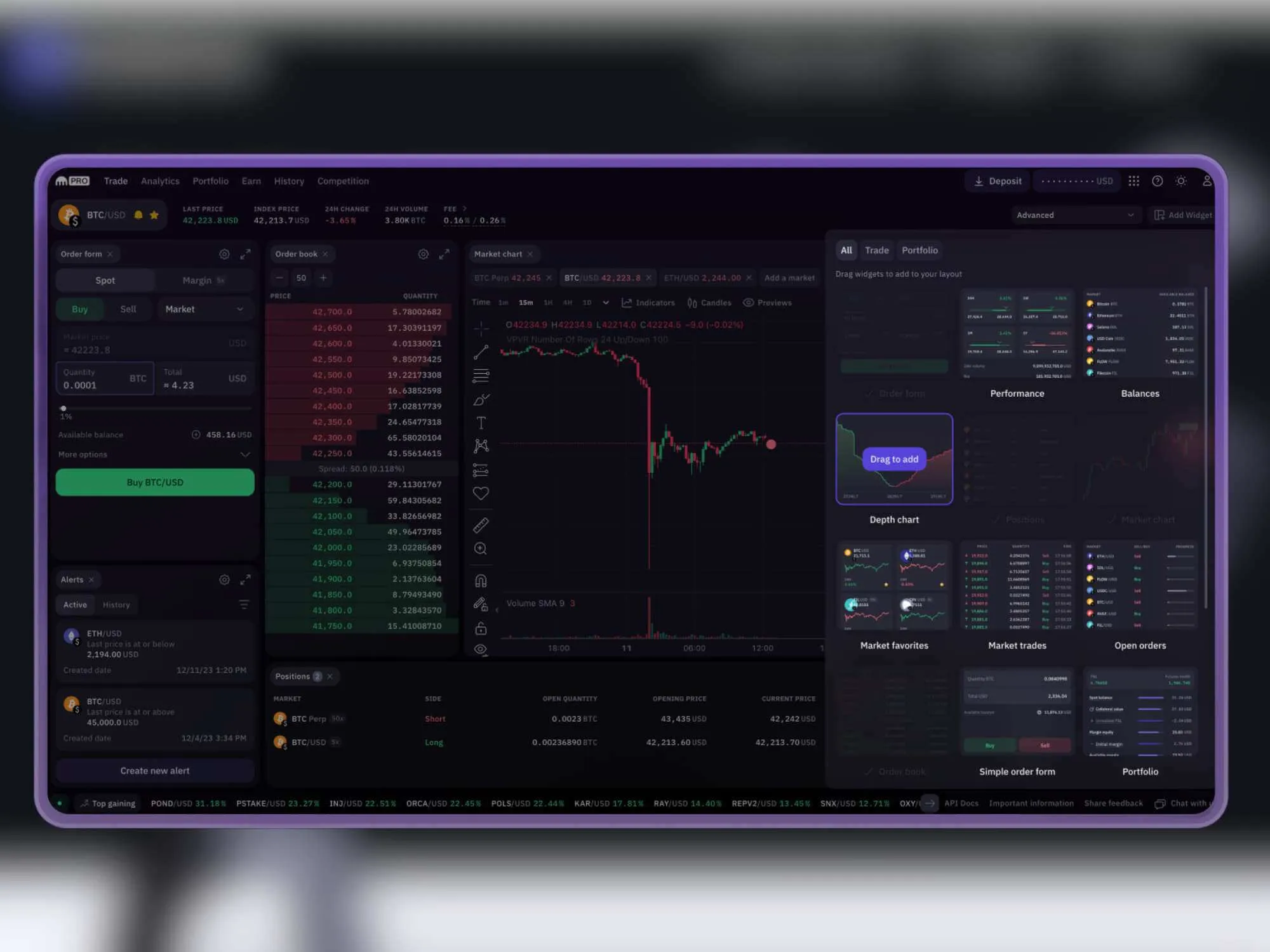
Kraken has a larger market, with more than 600 crypto assets in its public data compared to 417 on the Crypto.com Exchange. For margin trading and futures in the US, Kraken is the only choice of the two. Kraken Pro provides spot margin to eligible US retail clients, and Kraken offers US futures via Kraken Derivatives US, whereas the Crypto.com Exchange does not offer margin or derivatives trading to United States users. Crypto.com's US derivatives are non-margined contracts in the Crypto.com App, offered by Crypto.com | Derivatives North America, a unit overseen by the CFTC: crypto options (Strike and UpDown Options) and prediction and sports event contracts.
Ease of use
We rate both platforms equally for beginners and for operation. Both split their products into separate apps. Kraken includes the Kraken app for instant purchases and staking, and Kraken Pro for order-book trading, margin, and futures, all under one login. On Crypto.com, buying, staking, cards, and stocks are housed in the main Crypto.com App, while order-book trading is handled through its own Crypto.com Exchange App. In our view, the step from simple buying to the order book is a little easier on Kraken, where Kraken Pro sits under the same login.
Security, insurance and track record
Neither platform offers insurance for crypto assets. According to Kraken's legal disclosures, neither digital assets nor Kraken accounts are insured against losses. At Crypto.com, SIPC protection does not cover crypto held outside its broker-dealer, and cash in the US Cash Earn Account at Green Dot Bank is distributed across partner banks via a deposit sweep, potentially raising FDIC coverage to $5,000,000 per depositor under FDIC rules.
Their proof of reserves documentation varies. The latest proof of reserves from Kraken shows its BTC reserve ratio at 102.9%, with The Network Firm LLP as the attestation provider. Crypto.com's corresponding page still refers to a Mazars Group check of balances taken on December 7, 2022, and we found nothing newer there. Both platforms list security certifications, including ISO/IEC 27001:2022. Kraken settled SEC charges over its US staking program for $30 million in 2023, and a separate SEC case concluded in March 2025. Crypto.com states that the SEC closed its investigation of Crypto.com in March 2025 without enforcement action.
Our verdict by criterion
- Fees and costs: Kraken in our rating, although Crypto.com is cheaper at the first trading level
- Beginner friendliness and operation: even
- Range of functions: Kraken
- Security and trust: Kraken
- Support: Kraken
- Reach in the US: Crypto.com
Kraken suits you if margin trading in the US, low-cost Bitcoin withdrawals, or a larger coin selection are priorities. Crypto.com is better if you prefer trading small amounts on the order book with low entry fees, cards, and stocks in one app. If these options do not meet your needs, our picks for US customers highlight other platforms available in the US, our low-fee exchange list compares costs, and Coinbase vs Crypto.com and Coinbase vs Kraken include Coinbase. Our Kraken review and Crypto.com review provide complete coverage of each platform.
Questions about Kraken and Crypto.com
Is Crypto.com cheaper than Kraken?
For order-book trades initially, yes: the Crypto.com Exchange charges 0.25% and 0.50% at its first level, while Kraken Pro charges 0.40% and 0.80% at its first tier. For Bitcoin withdrawals, Kraken is significantly cheaper, at 0.000015 BTC compared to 0.0004 BTC on the Crypto.com Exchange.
Can you use Kraken or Crypto.com in New York?
No. Kraken does not operate in New York or Maine, and the Crypto.com App is not available in New York.
Can you trade on margin with either in the US?
Only with Kraken, where Kraken Pro provides spot margin trading to eligible US clients. The Crypto.com Exchange does not offer margin or derivatives trading in the United States.
About the author
At Exchange Flow, Ethan is recognized as the resident crypto expert. With 10+years of experience navigating the waters of global crypto exchanges, Ethan is a trusted voice in the ever-evolving world of digital currencies. He tests and scrutinizes exchanges so you don’t have to, offering reviews and articles that newbies and seasoned traders alike find invaluable. When he’s not coding, Ethan likes to travel and play retro games. He uses his crypto earnings to fund his trip around the globe.